Says “ India Supports Inclusive Global Order Free from the Law of the Jungle”
‘Viksit Bharat’ as a Guarantee for Global Stability
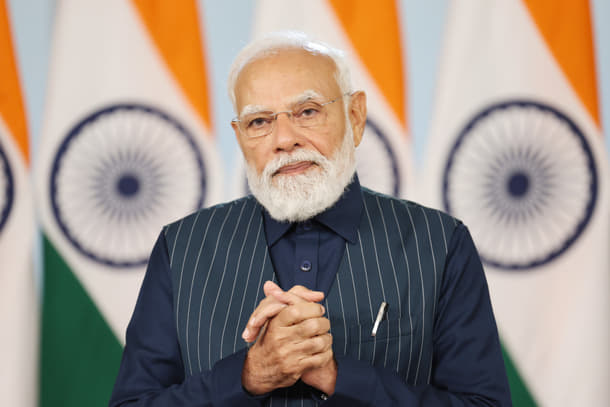
New Delhi: Pitching for a transformative framework in international diplomacy, Prime Minister Narendra Modi made a compelling case on Thursday for a newly envisioned global order anchored around humanity and the collective well-being of humankind. Delivering a landmark address at the NDTV World Summit, the Prime Minister stressed that international cooperation must remain unshakeable through turbulent crises while ensuring the Global South achieves its rightful voice and representation in multilateral governance.
Reflecting on the stark geopolitical fragmentations witnessed during the height of the COVID-19 pandemic, PM Modi critically observed, “At a time when cooperation was most needed, many nations that had earlier championed globalisation prioritised their own narrow interests.” He recalled proposing a “New World Order for the Collective Well-being of Humankind” originating from the G20 platform back in 2020, envisaging an administrative architecture with humanity at its foundational core.
The Prime Minister noted that systemic reforms across international bodies remain imperative, adding that robust diplomatic partnership cannot be treated as a fair-weather arrangement. Drawing a sharp historical parallel, PM Modi cited the ancient economic concept of Matsya Nyaya from the Arthashastra—a doctrine defining the law of the jungle where predatory entities devour the vulnerable. Modern civilization, he maintained, requires a stabilizing counter-framework capable of thwarting such exploitative forces, a vision driving India’s ongoing diplomatic efforts.
Emphasizing India’s role as a Vishwa Bandhu (friend to the world), PM Modi highlighted how the country dispatched life-saving vaccines and crucial medicines to over 100 nations during the global health catastrophe, even as several wealthy countries looked inward. “Guided by the principle of ‘Sabka Saath, Sabka Vikas’, India continues to act as a reliable partner rather than a self-interested power,” he stated.
He further pointed to India’s successful leadership of the G20 and BRICS summits, where consensus-driven joint declarations were achieved despite deep geopolitical rifts and skepticism. These diplomatic feats, he argued, demonstrate global faith in India’s role as a trusted bridge-builder and a stabilizing influence.
Connecting domestic growth with international stability, PM Modi asserted, “The vision of Viksit Bharat (Developed India) is not only for the country’s own progress but also a guarantee of stability and prosperity for the world. As India becomes more self-reliant, it strengthens global supply chains. A robust Indian economy and skilled youth contribute to global confidence in innovation and productivity.”
The Prime Minister reiterated that India is advancing rapidly toward becoming one of the world’s top three economies while maintaining its status as the fastest-growing major power. Highlighting India’s leadership in the green energy transition, its top-three status in artificial intelligence and startup ecosystems, and its pioneering real-time digital payment network, PM Modi noted that recent milestones—such as the operationalization of a critical breeder reactor, digital census methodologies, and the commissioning of the country’s inaugural hydrogen-powered train—underscore India’s expanding technological capabilities across sectors.