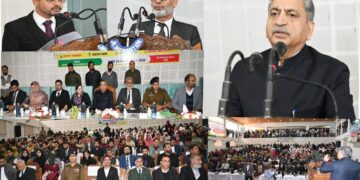
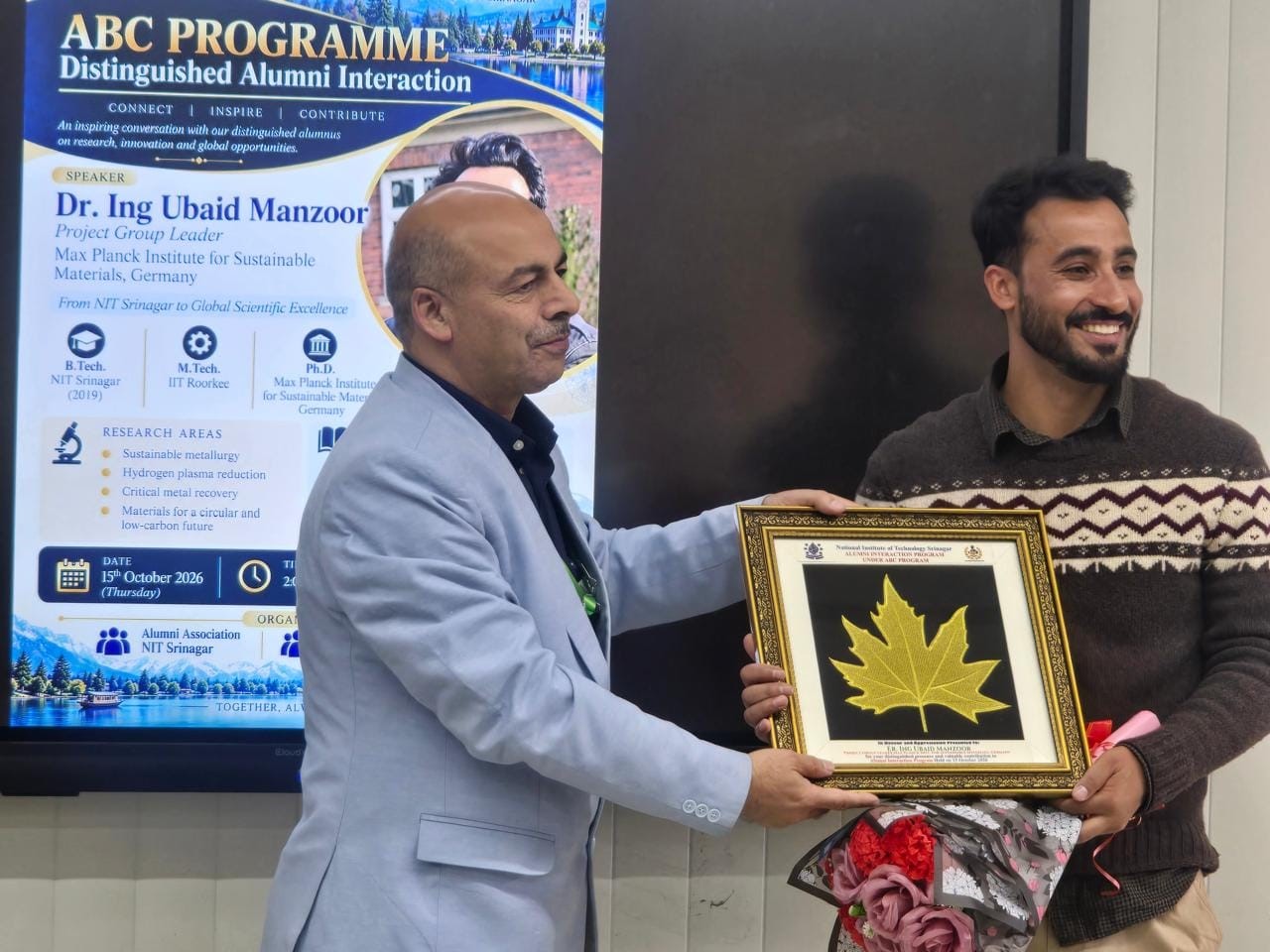
Srinagar : The Alumni Association of NIT Srinagar, in partnership with the Office of the Dean of Alumni and International Affairs, recently hosted an Alumni Back to Campus (ABC) Programme featuring the esteemed alumnus Dr. Ing Ubaid Manzoor, who serves as a Project Group Leader at the Max Planck Institute for Sustainable Materials in Germany.
The engaging event took place at the Hi-Tech Hall of NIT Srinagar. The session was led by Prof. M. A. Shah, the Dean of Alumni and International Affairs, alongside Ms. Toyiba, the Joint Secretary-II of the Alumni Association. During the interactive discussion, Dr. Manzoor made a compelling point that “the green energy transition is fundamentally a materials and metals transition.” He shed light on the increasing demand for essential metals like nickel, copper, and cobalt, which are crucial for batteries, renewable energy technologies, and modern infrastructure. He also pointed out the significant carbon footprint associated with traditional metal production, revealing that producing just one tonne of nickel can emit around 22–28 tonnes of CO₂. Dr. Manzoor stressed the urgent need for sustainable and energy-efficient alternatives to the conventional metallurgical processes we currently rely on. Drawing from his research published in prestigious journals like Nature and Science Advances, he introduced Hydrogen Plasma Smelting Reduction (HPSR), a groundbreaking technology that merges electrical energy, reactive hydrogen chemistry, and high-temperature processing to extract critical metals from low-grade nickel laterites and deep-sea polymetallic nodules. He explained how this innovative approach provides a cleaner alternative to traditional carbon-based extraction methods by combining reduction, melting, and separation into a single electrically driven process. Dr. Manzoor emphasized that achieving sustainable metallurgy goes beyond merely swapping carbon for hydrogen; it requires a complete redesign of metal production systems, focusing on cleaner energy, process integration, and resource-efficient technologies. Prof. M. A. Shah remarked that the programme offered students a valuable chance to delve into advanced materials research and grasp the pivotal role of science in shaping a sustainable future.