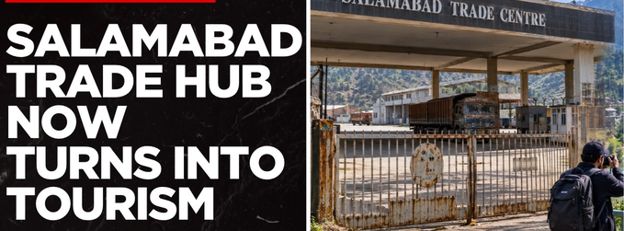
Srinagar| Sept: 21: Seven years after trucks stopped moving through the Salamabad Trade Facilitation Centre in Uri, the government has formally shifted the facility from its original commercial purpose to border tourism, marking a significant change in the role of one of Jammu and Kashmir’s most prominent cross-LoC landmarks.
The Tourism Department has taken over the Salamabad complex, which had remained largely unused since cross-LoC trade was suspended in April 2019. The existing infrastructure, including accommodation, cafeteria, open spaces and a viewpoint, is now being assessed for tourism-related activities and the development of a wider border tourism circuit.
The move has also brought renewed attention to the uncertain future of cross-LoC trade, which began in 2008 as part of confidence-building measures between the two sides. The barter-based system allowed traders to exchange a specified list of commodities without conventional banking or foreign-exchange transactions.
For traders who depended on the route, the closure brought an abrupt end to a business model that had linked markets on both sides of the Line of Control.
Bilal Ahmad Khan, a local trader said that people associated with the trade have already moved on to other businesses, but the memories of those years remain. If the opportunity comes again, many traders would be interested in returning,” said a former cross-LoC trader from north Kashmir.
“The Salamabad centre was built around the movement of goods and people. Its cargo facilities, offices, drivers’ accommodation and other infrastructure once catered to trucks operating between the two sides.Today, the same infrastructure is being viewed through a tourism lens,” he said.
A senior Tourism Department official said the government intends to use the facility to strengthen tourism in the Uri border belt, with plans focusing on visitor amenities and regulated access to designated viewpoints along the LoC. The department is also examining ways to involve private operators and local youth in tourism-related activities.
For residents of Uri, the decision offers a way to put a long-unused government facility back into service.
Another local Ghulam Hassan Khatana said that the centre’s conversion could help bring Uri onto the tourism map while creating employment opportunities for young people.
“Since the trade facility has remained unused for years, putting the infrastructure to productive use makes sense. Uri has considerable potential for border, religious and leisure tourism,” he added.
Local tourism stakeholders say the Salamabad complex could become part of a larger circuit covering scenic locations, heritage sites and designated LoC viewpoints.The shift, however, has not been universally welcomed as a substitute for the centre’s original purpose.
has argued that the facility was created not merely as a commercial complex but as part of a broader effort to reconnect people divided by the Line of Control. She has urged the Jammu and Kashmir government to take up the issue with the Centre and seek restoration of its original role.
The cross-LoC trade mechanism was introduced in October 2008 after the opening of the Srinagar-Muzaffarabad bus service in 2005. It was widely regarded as a confidence-building measure aimed at improving economic and people-to-people contacts across the divided region.
The arrangement remained in operation for about 11 years before being suspended in April 2019 following the Pulwama terror attack. The Centre subsequently cited security concerns and alleged misuse of the trade routes for illegal activities while announcing the suspension.
Since then, the Salamabad complex has largely stood idle.
Former CM and PDP President, Mehbooba Mufti in a post on X said that “Salamabad Trade Facilitation Centre was built to bridge divided families, revive trade and heal wounds, not be reduced to a mere tourist site. It came at a heavy price, with many PDP workers losing their lives during the Muzaffarabad Chalo rally.
“I urge CM to take this up with the GOI and restore its original purpose. Kashmir needs more bridges to the outside world, not the shutting of those that connect us,” she said in a post on X.
The latest administrative decision changes that status but leaves open a larger question: whether the tourism makeover represents a temporary repurposing of dormant infrastructure or a long-term departure from the idea of reviving cross-LoC commerce.
For traders who once waited for trucks to arrive at Salamabad, the transformation carries both economic and symbolic significance.
The cargo halls that once handled consignments are now being considered for visitors. The drivers’ facilities that once accommodated traders from across the LoC may become part of a tourism infrastructure. And a site once associated with cross-LoC commerce is now being positioned as a place from which visitors can look towards the Line of Control.
J&K Assembly session opens amid BJP protest, statehood slogans
• BJP MLAs enter Well over power tariff hike, workers’ demands • NC, Congress raise statehood issue as Assembly proceedings...
Read moreDetails