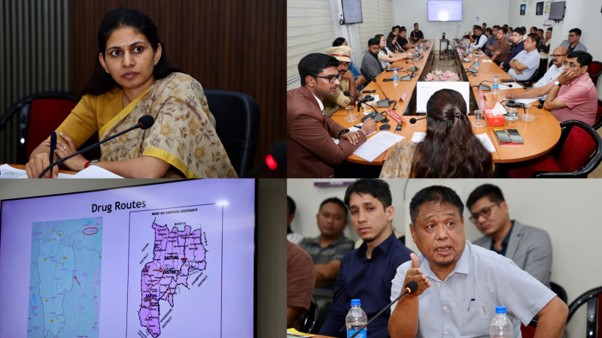
AIZAWL | Sept 16: Union Minister of State for Youth Affairs and Sports Raksha Khadse reviewed development priorities, implementation of Central Government schemes, sports infrastructure and youth engagement during district-level review meetings in Saitual and Kolasib districts of Mizoram on September 15 and 16.
In Saitual, the meeting was attended by District Collector Shriniwas Sadi, Superintendent of Police Vivek Kumar Maurya, senior officials and representatives of sports federations and community organisations.
Substance-abuse prevention among youth was a key issue discussed during the meeting. Khadse stressed greater coordination between youth groups, community organisations and law-enforcement agencies under the Nasha Mukt Bharat Abhiyaan. She also called for peer-led awareness programmes and sustained community-level interventions.
The meeting reviewed agriculture and horticulture activities, particularly the need to improve market access and supply linkages for Mizoram’s organic produce. Sports representatives also raised infrastructure and athlete-development requirements.
Khadse emphasised that sports infrastructure needs to be supported by regular coaching, structured training and sustained assistance to athletes. She also highlighted the Khelo India Scheme for expanding grassroots sporting opportunities.
In Kolasib, Khadse chaired a separate district review meeting attended by District Collector H. Dolianbuaia, Superintendent of Police Lalrinpuia Varte and senior district officials.
Road connectivity was among the major issues reviewed, with officials discussing access to markets, essential services and economic opportunities. The Minister also reviewed healthcare infrastructure, including the Community Health Centre, five Primary Health Centres and the nursing school.
Agriculture was another focus, with officials briefing the Minister on the role of the Krishi Vigyan Kendra (KVK). More than 10,000 farmers are active in the district, while the KVK provides technical guidance to over 5,000 growers, besides facilitating inter-state internships and visiting faculty programmes.
The review also covered 102 functioning cooperatives, largely engaged in agriculture, and the Janaushadhi Kendra, with discussions on strengthening livelihoods and community-level economic activity.
Khadse reviewed the implementation of the Prime Minister’s Employment Generation Programme (PMEGP), including issues related to portal access that had affected sanctions during 2025–26. Officials also discussed expediting assistance for 25 identified local enterprises, including furniture workshops, grocery stores and mineral-water units.
While reviewing the Public Distribution System and Pradhan Mantri Ujjwala Yojana, the Minister directed officials to address gaps in beneficiary data and maintain accurate records to ensure eligible households receive the intended benefits.
Sports infrastructure and athlete development also figured prominently in the Kolasib meeting. Football, hockey and wrestling were identified as major sporting disciplines in the district. The need for a dedicated training centre was discussed to provide athletes with structured coaching and regular training.
Khadse also reviewed sports infrastructure being developed under the VB-GRAM-G initiative, including football and volleyball grounds and maintenance of existing facilities. She suggested developing sports grounds across the district’s 51 villages to improve access for young people.
Youth mobilisation and substance-abuse prevention were also discussed. Officials briefed the Minister on Nasha Mukt initiatives, while the District Youth Officer informed the meeting that around 9,000 youth are registered on the MY Bharat platform in Kolasib.
Khadse called for greater mobilisation of MY Bharat volunteers for awareness activities and stronger coordination between volunteers and the Police Department.
The Minister stressed the need to channelise youth towards sports, education, entrepreneurship, community service and productive livelihoods. She also emphasised accurate beneficiary data, inter-departmental coordination and continuous engagement with local communities for effective implementation of government schemes.
The meetings concluded with emphasis on coordination among district administrations, police, sports bodies, youth institutions, agricultural organisations, cooperatives and community groups for improving development outcomes and creating greater opportunities for young people in Saitual and Kolasib.