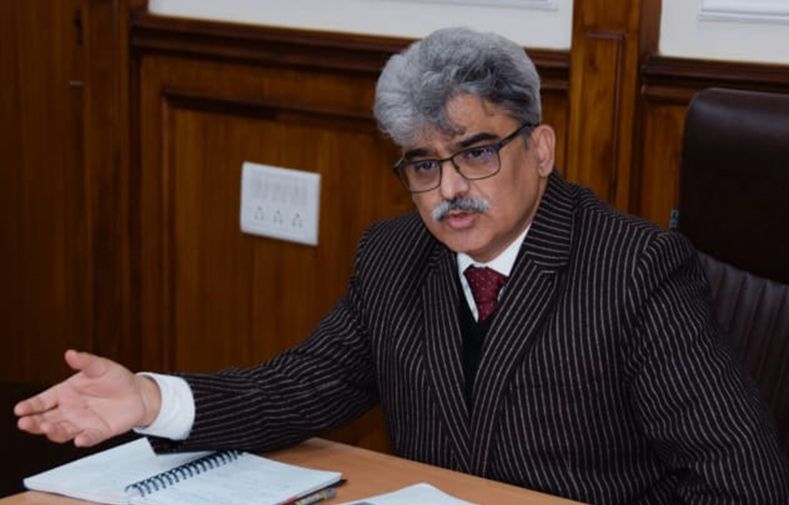
Srinagar :Chief Secretary Atal Dulloo on Monday reviewed preparations for the Phase-I pilot of the Rehabilitation & Socio-Economic Reintegration Scheme for Drug Abuse Victims, 2026, and directed the Social Welfare Department to ensure its early commencement.
Chairing a high-level meeting, the Chief Secretary reviewed the readiness of identified pilot institutions and districts, availability of manpower and infrastructure, capacity-building initiatives, inter-departmental coordination and the proposed digital mechanism for end-to-end monitoring of beneficiaries.
The Phase-I pilot is proposed to be implemented at IMHANS Srinagar, Addiction Treatment Facilities (ATFs) at Jammu and Kathua, and in Budgam district. The pilot will test the rehabilitation model on the ground, identify operational gaps, refine Standard Operating Procedures and generate learning for its subsequent expansion across Jammu and Kashmir.
Dulloo reviewed infrastructure and manpower availability at each pilot location and stressed focused training for Medical Officers, Counsellors, Case Managers, ASHA workers and Self Help Group members. He directed the Social Welfare Department to coordinate implementation and ensure that the pilot begins at the earliest.
He also directed the department to simultaneously identify the human resources and infrastructure required to extend the rehabilitation mechanism to other districts, allowing the pilot to serve as a foundation for wider implementation.
The Chief Secretary stressed the importance of ground-level coordination among all stakeholders and said the success of the programme would depend on each agency performing its designated role and ensuring seamless coordination throughout the rehabilitation process.
He reviewed capacity-building initiatives undertaken by IMHANS Srinagar and directed the institute to continue training programmes across districts to create a skilled pool of personnel capable of supporting the programme as it expands.
Dulloo further directed the National Informatics Centre (NIC) to complete the Rehabilitation Monitoring Portal (RMP) without further delay. The proposed portal will facilitate confidential, end-to-end digital case management, with beneficiaries assigned a Unique Digital ID and role-based access restricted to authorised officials.
The Chief Secretary stressed the need to develop a trained multidisciplinary workforce capable of screening, assessment, referral, counselling, family engagement, case management and relapse-risk identification while maintaining confidentiality and ethical standards.
Commissioner Secretary, Social Welfare Department, Sarmad Hafeez, briefed the meeting on the proposed implementation framework, site readiness, manpower requirements, capacity-building measures and digital monitoring mechanism.
The meeting was informed that pilot locations would require medical, counselling and social-work facilities, including doctors’ rooms, counselling spaces, group therapy facilities and referral and emergency linkages. The facilities would also have identified Medical Officers/Psychiatrists, Counsellors and Social Welfare Officials/Case Managers, with community-level linkages through ASHA workers and Self Help Groups.
The meeting also discussed strengthening addiction psychiatry capacity through a proposed collaboration with the National Drug De-addiction & Treatment Centre (NDDTC), AIIMS New Delhi, covering structured training, mentoring, observerships and joint research in addiction psychiatry, opioid agonist treatment, dual-diagnosis management and rehabilitation interventions.
Head, IMHANS Srinagar, Dr Arshad Hussain, briefed the meeting on interventions undertaken by the institute and facilities covered under the pilot. He said training modules for different categories of personnel had been developed and several batches had already undergone training.
The meeting was informed that the first phase of the Circle of Care training module had been completed, with more than 300 frontline workers, including ASHA workers, NRLM/SHG representatives and teachers, trained across Kashmir Division. The next phase proposes to train 1,020 participants through 34 cohorts across J&K.
The capacity-building programme will cover screening and referral, counselling and family engagement, Individual Rehabilitation Plans, case management, relapse-risk identification, confidentiality, ethical handling and portal-based reporting.
The meeting also reviewed a proposed programme to train Higher Secondary and College teachers, with the aim of ensuring that at least one teacher in every institution is trained as an institution-based counsellor for prevention, early identification and referral of substance-use disorders. The initiative proposes coverage of around 2,200 Higher Secondary Schools and Colleges across J&K.
Officials said the Rehabilitation Monitoring Portal would cover assessment, treatment, counselling, stabilisation, risk classification, rehabilitation plans, referral, vocational support and follow-up while enabling real-time inter-departmental coordination and programme monitoring.
The coordinated Phase-I pilot is expected to provide operational learning for strengthening the rehabilitation model and preparing it for Union Territory-wide implementation.
Srinagar airport lifts operational restrictions ahead of winter schedule
• Late-evening flights expected to improve connectivity from October 25 Srinagar|Oct, 19: Srinagar International Airport has withdrawn restrictions limiting its...
Read moreDetails