
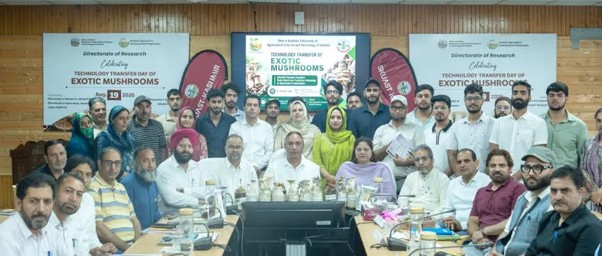
Srinagar : Sher-e-Kashmir University of Agricultural Sciences and Technology of Kashmir (SKUAST-K) has successfully transferred its patented exotic mushroom production technology to the Department of Agriculture, aiming to enhance agricultural practices among farmers and agri-entrepreneurs in Jammu and Kashmir. This technology, developed by the Mushroom Research and Training Centre (MRTC), focuses on the cultivation of three high-value exotic mushrooms: Shiitake, King Oyster, and Enoki, along with their associated strains.
The transfer initiative, organized by the Directorate of Research at SKUAST-K, is designed to bridge the gap between academic research and practical application in the agricultural sector. It promotes sustainable agricultural practices by utilizing locally available woody biomass, such as apple-pruning waste, which is often discarded. This approach not only transforms waste into a valuable resource but also supports a waste-to-wealth model, contributing to economic sustainability. Vice-Chancellor Prof Nazir Ahmad Ganai emphasized the potential of exotic mushroom cultivation to transition agriculture towards a more resource-efficient and knowledge-intensive model. He noted that these mushrooms fetch significantly higher prices than traditional button mushrooms, thereby creating opportunities for small-scale enterprises, particularly benefiting rural youth, women, and educated agricultural graduates. The university estimates that the available horticultural biomass in J&K could support the production of approximately 3.4 lakh tonnes of premium mushrooms annually, with a market value estimated at around Rs 17,000 crore. Director Agriculture Sartaj Ahmad Shah acknowledged the necessity of agricultural diversification in response to increasing land and resource pressures, highlighting the low land requirements and high-value nature of mushroom cultivation. He assured support for disseminating this technology to farmers and potential entrepreneurs. Additionally, Director Extension Prof Raihana Habib Kanth noted the initiative’s alignment with the Holistic Agriculture Development Programme (HADP), which aims to translate scientific advancements into practical opportunities for farmers. Dr. Khursheed Ahmad Bhat, the MRTC In-charge, provided a technical overview of the production systems and infrastructure necessary for mushroom cultivation. Entrepreneurs who have piloted the technology shared their positive experiences, underscoring its commercial viability and potential for income generation. A technology book detailing exotic mushroom cultivation and the utilization of agricultural waste was also launched during the event. This initiative, supported under HADP-10, aspires to foster agri-entrepreneurship, create employment opportunities, and establish Jammu and Kashmir as a hub for exotic, nutritional, and medicinal mushroom production.