3 hours of debate across both Houses, Key reforms on exams, minerals and MSMEs
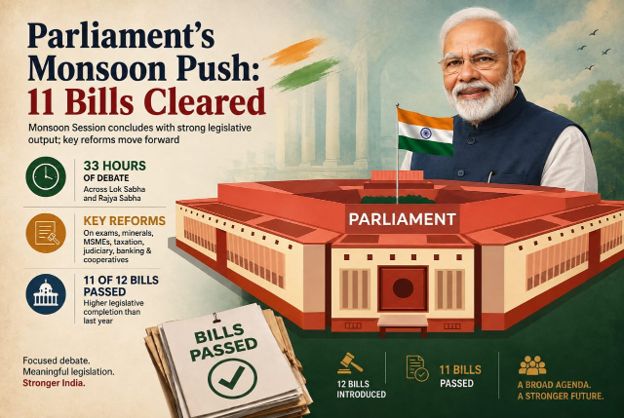
 New Delhi: Parliament’s Monsoon Session concluded with a strong legislative record, with 11 of the 12 Bills introduced during the session passed by both Houses, reflecting a focused legislative agenda and steady progress on a range of issues covering examinations, taxation, MSMEs, banking, judicial administration, minerals, cooperative development and other areas. The session concluded on August 13 with both the Lok Sabha and Rajya Sabha being adjourned sine die. The Indian Statistical Institute Bill, 2026, was the only one among the 12 Bills introduced during the session that remained pending. According to data cited from PRS Legislative Research, the 11 Bills passed during the session accounted for nearly 33 hours of parliamentary discussion across both Houses, demonstrating detailed consideration of legislation alongside the legislative productivity achieved during the session.
11 Bills Passed, Broad Legislative Agenda Covered: The 12 Bills introduced during the session were brought before Parliament between July 20 and August 10, with 11 eventually securing approval from both Houses. The legislation covered a diverse range of sectors and institutional areas. Among the important measures were amendments relating to public examinations, national honour, registration of births and deaths, the Supreme Court, MSMEs, taxation, banking records, tribunals, the naming of Kerala and cooperative development. The Mines and Minerals (Development and Regulation) Amendment Bill, 2026, was also passed by the Rajya Sabha on the final day of the session after being cleared by the Lok Sabha. The legislative record indicates the government’s ability to advance a wide-ranging policy agenda within the available parliamentary calendar.
Nearly 33 Hours Of Debate Across Two Houses: The Bills passed during the session received a combined 32 hours and 58 minutes of discussion in the two Houses, according to the PRS data cited by Business Standard. The Lok Sabha accounted for nearly 12 hours of discussion, while the Rajya Sabha contributed around 21 hours. The Public Examinations (Prevention of Unfair Means) Amendment Bill, 2026, received the highest amount of discussion, with 17 hours and 34 minutes devoted to it across both Houses. The Bill was discussed for 10 hours and 55 minutes in the Lok Sabha and another six hours and 39 minutes in the Rajya Sabha. The extensive discussion on the examination-related legislation reflected the importance attached to strengthening the integrity and fairness of public examinations. The remaining 10 Bills together accounted for more than 15 hours of discussion.
Legislation Covering Key Areas of Governance: The Monsoon Session’s legislative agenda touched several areas that have a direct bearing on governance and economic activity. The MSME Development (Amendment) Bill addressed an important segment of India’s economy, while the Taxation and Other Laws (Amendment) Bill related to the country’s fiscal and regulatory framework. The Bankers’ Books Evidence Bill dealt with an area connected to financial and banking processes, while the Tribunals Reforms Bill focused on institutional and judicial administration. The Registration of Births and Deaths (Amendment) Bill concerned the country’s civil registration framework, while the Supreme Court (Number of Judges) Amendment Bill addressed the sanctioned strength of judges in the apex court. The National Co-operative Development Corporation (Amendment) Bill focused on the cooperative sector, an important component of the government’s wider rural and economic development agenda.
Parliament Advances Public Examination Reforms: The Public Examinations (Prevention of Unfair Means) Amendment Bill emerged as the most extensively debated legislation of the session. With more than 17 hours of discussion across both Houses, the legislation received significantly more parliamentary time than the other Bills. The focus on public examinations comes amid a wider national emphasis on ensuring transparency, fairness and credibility in recruitment and competitive examinations. The legislative process provided MPs across the two Houses an opportunity to deliberate on measures aimed at strengthening the examination system and addressing unfair practices.
Mineral Sector Gets Legislative Attention: The Mines and Minerals (Development and Regulation) Amendment Bill, 2026, was among the key pieces of legislation passed during the session. The Bill was cleared by the Lok Sabha and subsequently passed by the Rajya Sabha on the final day. The legislation comes against the backdrop of India’s growing focus on mineral security and the importance of domestic access to resources required for manufacturing, energy transition, electronics, infrastructure and advanced technologies. Critical and strategic minerals have become increasingly important to economies worldwide, making the strengthening of India’s mineral ecosystem a key policy priority.
MSMEs and Cooperative Sector In Focus: The Monsoon Session also advanced legislation concerning two important pillars of the Indian economy — MSMEs and cooperatives. The MSME Development (Amendment) Bill formed part of the session’s legislative agenda, reflecting the importance of small businesses to employment generation, entrepreneurship and local economic activity. Similarly, the National Co-operative Development Corporation (Amendment) Bill focused on strengthening the institutional framework supporting the cooperative sector. Together, these measures underline the importance of broad-based economic participation, particularly in sectors that connect rural communities, entrepreneurs and smaller enterprises with the formal economy.
Judicial, Institutional Reforms: The session also dealt with important judicial and institutional matters. The Supreme Court (Number of Judges) Amendment Bill addressed the sanctioned strength of judges in the apex court, while the Tribunals Reforms Bill focused on the functioning of tribunals. The legislation reflects the continuing effort to strengthen institutions and improve the efficiency of the justice delivery system. The passage of these measures adds to the wider legislative work aimed at modernising governance structures and ensuring that institutions remain capable of meeting changing requirements.
Taxation, Banking Frameworks Also Updated: The Taxation and Other Laws (Amendment) Bill was another important piece of legislation passed during the session. The Bill formed part of the government’s continuing efforts to update the country’s tax and legal framework in line with changing economic requirements. The Bankers’ Books Evidence Bill, meanwhile, addressed the legal framework governing banking records and evidence. Together, the measures highlight Parliament’s role in keeping financial and regulatory systems aligned with the needs of a rapidly changing economy.
Legislative Pace Reflects Focused Parliamentary Agenda: The passage of 11 Bills out of 12 introduced during the session indicates a high degree of legislative completion. Compared with the 2025 Monsoon Session, when 13 Bills were introduced and eight were passed within the session, the 2026 session recorded a higher proportion of Bills being cleared. The comparison also highlights the focused nature of the current session, with the government able to move a majority of its legislative proposals through both Houses within the scheduled period. The Indian Statistical Institute Bill, 2026, remained pending and can be considered in subsequent parliamentary proceedings.
A Continuation Of Legislative Momentum: The Monsoon Session followed the Budget Session of 2026, during which 13 government Bills were introduced and nine were passed. One Bill was voted down, two became infructuous and one remained pending during that session. The Budget Session also witnessed an extension of three days for delimitation-related legislation. The three Bills introduced during that extended period were discussed for 21 hours and 28 minutes over two days. The Constitution (131st Amendment) Bill was voted down, after which the other two Bills became infructuous. The legislative activity across the two sessions demonstrates the continued pace of parliamentary business during 2026.
A Diverse Legislative Portfolio: The Monsoon Session’s Bills covered a wide range of subjects rather than being concentrated in a single policy area. From examination reforms and mineral development to taxation, MSMEs, banking, judicial administration and cooperative development, the legislative agenda reflected multiple dimensions of governance and economic policy. Such a broad portfolio also indicates the range of issues being addressed through Parliament as India continues to expand its economy and modernise its institutional frameworks.
Parliamentary Debate Remains Central To The Process: The nearly 33 hours devoted to the 11 Bills also underline the role of parliamentary debate in the legislative process. While the amount of time devoted to individual Bills varied according to their subject and complexity, the overall figure represents substantial discussion across the two Houses. The Public Examinations Amendment Bill received the largest share of attention, while other legislation received shorter discussions. The passage of the Bills after consideration by both Houses demonstrates the constitutional process through which proposed legislation moves from introduction to approval.
A Productive Session Sets The Stage For Further Reforms: The Monsoon Session has concluded with most of the government’s legislative agenda successfully advanced. With 11 Bills passed and nearly 33 hours of discussion recorded on the legislation, the session combined legislative output with parliamentary debate across a range of important policy areas. The measures concerning examinations, minerals, MSMEs, taxation, banking, judicial institutions and cooperatives will now form part of the country’s evolving legal and governance framework. For the government, the session represents another step in advancing its reform and development agenda. For Parliament, it adds another chapter to the continuing process of updating laws to respond to India’s changing economic, technological and institutional needs. The Monsoon Session’s record of 11 Bills passed out of 12 introduced also demonstrates the ability of Parliament to take forward a substantial legislative programme within a defined timeframe. As the Houses now move towards their next phase of legislative business, the measures passed during the Monsoon Session will provide the policy and legal foundations for further reforms. The session, therefore, closes with a clear message of legislative momentum: Parliament has moved forward on a broad range of issues, while the government’s wider reform agenda continues to take shape through the democratic process of debate, consideration and approval.