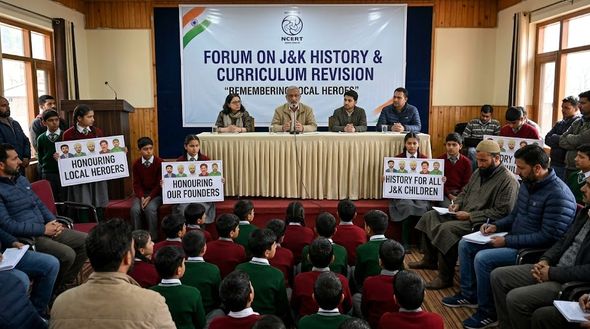
Says “New textbooks provide ‘due space’ to regional histories,local contributions”
“NCERT has released new syllabi and textbooks for Classes 1 to 9”
SrinagarContributions of freedom fighters and local leaders from Jammu and Kashmir are set to receive greater space in school history education as part of the ongoing revision of NCERT textbooks under the National Education Policy (NEP) 2020.
The Union Ministry of Education informed the Rajya Sabha that the new textbooks developed by the National Council of Educational Research and Training (NCERT) seek to present India’s freedom struggle in a “comprehensive and inclusive manner”, with due space for regional histories, local contexts and contributions of individuals and communities.
The issue was raised by Rajya Sabha member Sat Paul Sharma, who sought to know whether steps were being taken during NCERT textbook revisions to include the contributions of freedom fighters from Jammu and Kashmir in the national history curriculum.
He also sought details of initiatives undertaken to document and promote the contributions of local leaders associated with the national freedom movement.
Minister of State for Education Jayant Chaudhary said the NCERT has brought out the National Curriculum Framework for School Education (NCF-SE) 2023 in accordance with the recommendations of NEP 2020.
The framework provides the basis for stage-wise and subject-wise curricular goals, competencies, learning outcomes, syllabi, textbooks, pedagogy and assessment.
As a follow-up to the NCF-SE 2023, NCERT constituted the National Syllabus and Teaching-Learning Material Committee (NSTC), under which 13 Curricular Area Groups (CAGs) and Textbook Development Teams (TDTs) have been established for different subjects and grades.
The NSTC has been entrusted with developing teaching-learning material, including textbooks.
The committees include scholars, subject experts, teachers, teacher educators, artists, renowned sportspersons, NCERT faculty members and officials and faculty members from State Councils of Educational Research and Training (SCERTs).
The government said NCERT has, with the support of the NSTC, brought out new syllabi and textbooks for Grades 1 to 9.
According to the Ministry, the revised textbooks specifically provide greater attention to regional histories and local contexts.
The government said the Grade 8 Social Science (Part 1), Chapter 4 — “The Colonial Era in India”, and Grade 8 Social Science (Part 2), Chapter 2 — “India’s Long Road to Independence”, mention contributions of several local leaders associated with the national freedom movement.
The Ministry maintained that the approach is intended to make the teaching of India’s freedom struggle more comprehensive by recognising contributions beyond the better-known national figures.
For Jammu and Kashmir, the move could provide an opportunity for the stories of local freedom fighters and leaders to be incorporated more prominently into the broader national narrative.
The Centre also clarified that NEP 2020 allows States and Union Territories to incorporate region-specific content into their curricula and textbooks.
Para 4.32 of NEP 2020 provides that States may prepare their curricula and textbooks on the basis of the NCF-SE and material developed by NCERT while incorporating “State flavour and material as needed”.
The government said NCERT textbooks provide the national curricular perspective, while States and Union Territories can suitably incorporate material relating to their own history, culture and contributions of local personalities.
This provision assumes particular significance for Jammu and Kashmir, where local historical figures and movements can be incorporated into school education alongside the national history curriculum.
The Ministry further pointed out that education is a subject under the Concurrent List of the Constitution, while the majority of schools are under the jurisdiction of respective State and Union Territory governments.