NHM funding rises from ₹459 crore in 2021-22 to over ₹1,017 crore in 2025-26
25 lakh families covered under Ayushman Bharat
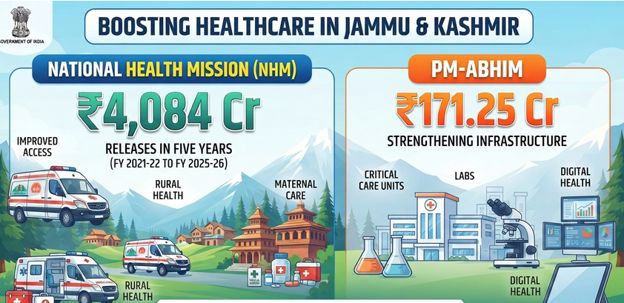
Srinagar: The Centre released ₹4,083.74 crore under the National Health Mission (NHM) to Jammu and Kashmir over the last five financial years, while another ₹171.25 crore was released under the Pradhan Mantri Ayushman Bharat Health Infrastructure Mission (PM-ABHIM), Parliament was informed on Tuesday.
The figures were provided by Minister of State for Health and Family Welfare Prataprao Jadhav in a written reply to an unstarred question in the Rajya Sabha by BJP MP Ghulam Ali.
The data shows a more than two-fold increase in annual NHM releases during the period. The Centre released ₹459.10 crore in 2021-22, which increased to ₹651.52 crore in 2022-23, ₹805.22 crore in 2023-24 and ₹1,040.76 crore in 2024-25. The release stood at ₹1,017.14 crore in 2025-26.
Under PM-ABHIM, the Centre released ₹16.11 crore in 2021-22, ₹1 crore in 2022-23, ₹44.01 crore in 2023-24, ₹60.44 crore in 2024-25 and ₹49.69 crore in 2025-26.
Taken together, the two central health infrastructure and public-health programmes received ₹4,254.99 crore in central releases during the five-year period.
The Centre said Ayushman Bharat Pradhan Mantri Jan Arogya Yojana has been implemented in Jammu and Kashmir in convergence with the AB-PMJAY SEHAT scheme.
According to the State Health Agency, 25 lakh families are covered in the Union Territory. Of these, 6.70 lakh families are covered under AB-PMJAY, while the remaining eligible families are covered exclusively under AB-PMJAY SEHAT.
The Centre said AB-PMJAY provides health cover of up to ₹5 lakh per family per year for secondary and tertiary hospitalisation to around 55 crore beneficiaries nationally.
The scheme has also been expanded to cover senior citizens aged 70 years and above, irrespective of their socio-economic status, under the Ayushman Vay Vandana Card.
The government said district-wise details of hospital admissions authorised under PM-JAY for the five financial years from 2021-22 to 2025-26 have been provided in an annexure to the parliamentary reply.
The Centre also said its eSanjeevani telemedicine service has been implemented across all States and Union Territories, including Jammu and Kashmir.
As of July 31, 2026, the national telemedicine platform had served more than 48.9 crore patients through a network of 1,41,368 health facilities, supported by 19,264 hubs and 776 online OPDs.
District-wise details of teleconsultations in Jammu and Kashmir have also been provided in the annexure accompanying the reply.
The government said the TB Mukt Bharat Abhiyan is being implemented across Jammu and Kashmir under the National Health Mission.
The programme includes screening of vulnerable populations, chest X-ray-based detection, upfront nucleic acid amplification testing for presumptive TB cases, timely treatment, differentiated care for high-risk patients, nutrition support and preventive treatment for eligible vulnerable groups.
District-wise TB notification figures for the last five years have been provided through the Nikshay portal, the government said.
The Centre also provided details of Intensified Mission Indradhanush rounds conducted in J&K during the past five years.
Responding to questions on district-wise implementation delays, utilisation of funds and timelines for universal healthcare coverage, the Ministry said public health and hospitals are a State/UT responsibility and implementation of the programmes falls under the jurisdiction of the respective government.
The Centre said it provides technical and financial support to Jammu and Kashmir under NHM based on proposals submitted through Programme Implementation Plans. Approvals are issued through Records of Proceedings according to scheme norms and available resources.
For PM-ABHIM, the government said the ₹64,180-crore mission is aimed at strengthening health infrastructure through support for Sub-Health Centres, Urban Ayushman Arogya Mandirs, Block Public Health Units, Integrated District Public Health Laboratories and Critical Care Hospital Blocks.