Rail Minister says all-weather rail link is opening national markets for Kashmir’s apples, handicrafts and MSMEs
Surveys cleared for Jammu–Poonch rail line; cargo terminals, station redevelopment and Kavach expansion gather pace
J&K’s entire broad gauge rail network electrified;
4 Amrit Bharat stations under redevelopment, new trains planned
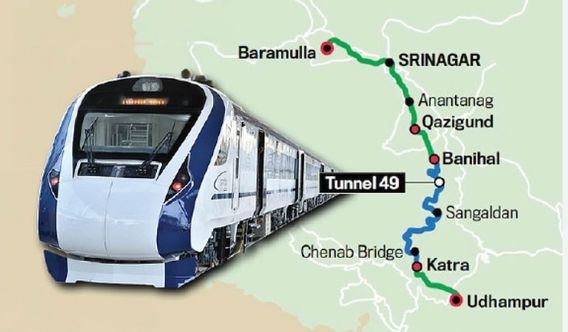
Srinagar: The Union Government on Friday said that the completion of the 272-km Udhampur-Srinagar-Baramulla Rail Link (USBRL) has ushered in a new era of all-weather connectivity for Jammu and Kashmir, transforming the Union Territory’s transport landscape while creating unprecedented opportunities for trade, tourism, agriculture and regional economic growth.
Replying to a question in the Rajya Sabha, Union Minister for Railways, Information & Broadcasting and Electronics &Information Technology Ashwini Vaishnaw said the landmark railway project has enabled seamless rail connectivity between Kashmir Valley and the rest of the country, allowing local farmers, artisans and entrepreneurs to access national markets more efficiently and reliably than ever before.
The Minister said the commissioning of USBRL has significantly reduced travel time between Shri Mata Vaishno Devi Katra and Srinagar to nearly three hours, providing an all-weather alternative to the Jammu-Srinagar National Highway, which frequently witnesses disruptions due to landslides, snowfall and adverse weather.
Highlighting the socio-economic impact of the project, Vaishnaw said the railway network has become a catalyst for economic development across Jammu and Kashmir by improving the movement of both passengers and freight.
“With reliable rail connectivity, farmers and local businesses are now able to transport signature Kashmir products such as apples, dry fruits, pashmina shawls and handicrafts to markets across the country, thereby expanding business opportunities and promoting economic diversification,” the Minister said.
He added that easier transportation of raw materials and finished products has also strengthened the region’s small and medium enterprises (SMEs), while the tourism sector is expected to witness significant growth due to improved accessibility.
Describing USBRL as one of the most challenging railway infrastructure projects undertaken in independent India, the Minister said the 272-km railway line traverses the geologically fragile young Himalayan mountain ranges, presenting engineers with complex geological surprises and difficult terrain.
Among the project’s most iconic achievements is the Chenab Railway Bridge in Reasi district, now recognised as the world’s highest railway arch bridge. The bridge stretches 1,315 metres, features an arch span of 467 metres, and stands 359 metres above the Chenab riverbed, making it one of the most significant engineering feats in modern railway history.
The project also includes India’s first cable-stayed railway bridge across Anji Khad, measuring 473 metres in length and supported by a 193-metre-high inverted Y-shaped single pylon.
Apart from the railway alignment itself, the project has led to the construction of nearly 215 kilometres of approach roads, several tunnels and over 320 bridges, many of which have improved road access for local communities living in remote mountainous areas.
The entire USBRL corridor has been fully electrified using overhead conductor systems in both tunnels and open stretches, making the entire existing broad gauge railway network in Jammu and Kashmir completely electrified.
The Government also outlined an ambitious roadmap for further railway expansion in Jammu and Kashmir.
Vaishnaw informed Parliament that the Final Location Survey (FLS) has been sanctioned for the strategically important 190-km Jammu/Reasi-Poonch new railway line, with field surveys already underway for preparation of the Detailed Project Report (DPR).
The proposed railway line is expected to significantly strengthen connectivity in the border districts of Rajouri and Poonch once approved.
Another survey is also underway for the proposed 78-km Jammu-Shri Mata Vaishno Devi Katra additional railway line, while the DPR has already been prepared for the proposed third railway line between Jalandhar Cantt and Jammu Tawi, aimed at increasing capacity on one of northern India’s busiest railway corridors.
The Minister clarified that after preparation of DPRs, the projects will require consultations with stakeholders, appraisal by NITI Aayog, approval from the Ministry of Finance and other statutory clearances before execution.
To improve freight logistics, the Railways has commissioned one Gati Shakti Multi-Modal Cargo Terminal (GCT) in Samba district, while in-principle approvals have been granted for three additional terminals in Kathua, Jammu and Anantnag districts.
Vaishnaw said the Gati Shakti Cargo Terminal policy has already attracted nearly ₹10,000 crore in private investment across the country, with 142 cargo terminals commissioned so far having a freight handling capacity of 224 million tonnes annually.
The additional terminals in Jammu and Kashmir are expected to reduce logistics costs, improve freight movement and facilitate transportation of horticulture produce, industrial goods and construction material.
Under the Amrit Bharat Station Scheme, four railway stations in Jammu and Kashmir—Budgam, Jammu Tawi, Martyr Captain Tushar Mahajan Station and Shri Mata Vaishno Devi Katra—have been selected for comprehensive redevelopment.
At Budgam station, works relating to the circulating area, parking and approach road have already been completed, while construction of a new 12-metre-wide foot over bridge, improved station building and executive lounge is in progress.
At Jammu Tawi station, a new station building at the second entry, additional platforms, parking facilities, circulating area, platform shelters, entrance ramps and an electrical substation have been completed. Work on a modern air concourse, new foot over bridges and redevelopment of the main station building is currently underway.
At Martyr Captain Tushar Mahajan station, station buildings, parking areas, waiting halls, toilets, signage and approach roads have been upgraded, while construction of platform shelters and a six-metre-wide foot over bridge is in progress.
Master planning for Shri Mata Vaishno Devi Katra station is currently under preparation.
The Minister said redevelopment works include wider foot over bridges, lifts, escalators, executive lounges, improved waiting halls, kiosks under the “One Station One Product” initiative, landscaping and enhanced passenger amenities.
The Railways is also strengthening safety infrastructure in Jammu and Kashmir through modern signalling systems.
Vaishnaw said Electronic Interlocking, Complete Track Circuiting and Block Proving Axle Counter (BPAC) systems have been installed at 11 railway stations across Samba, Reasi, Ramban, Kathua and Jammu districts during the last five years.
The Government has also sanctioned installation of the indigenous Kavach Automatic Train Protection System over 401 route kilometres, covering the Kathua-Jammu Tawi, Jammu Tawi-Katra, Katra-Banihal and Banihal-Baramulla sections.
Kavach automatically applies brakes if a locomotive pilot fails to respond appropriately, significantly improving train safety and reducing the possibility of collisions.
The Minister said Indian Railways currently operates four pairs of Vande Bharat Express trains serving Jammu and Kashmir, including services connecting Jammu Tawi, Srinagar, Shri Mata Vaishno Devi Katra and Amritsar, besides the New Delhi-Katra Vande Bharat.
The Railways has also decided to introduce a Shri Mata Vaishno Devi Katra-Budgam Express, further improving connectivity between Jammu and Kashmir regions.
Additionally, long-distance trains from Durg, Indore and other cities have been extended up to MCTM Udhampur, increasing connectivity for passengers travelling to the Union Territory.
At present, Jammu Tawi station is served by 114 train services, MCTM Udhampur by 58, Shri Mata Vaishno Devi Katra by 46, Budgam by 19, while Srinagar station currently handles 16 train services.
The Minister informed the House that 195 Road Over Bridges (ROBs) and Road Under Bridges (RUBs) currently exist across Jammu and Kashmir, while two additional ROB projects worth approximately ₹87 crore are under implementation.
Northern Railway has been allocated ₹763 crore under Plan Head-30 during the current financial year for ROB/RUB works, with ₹229 crore already spent up to May 2026.
Vaishnaw further said nearly 99.6 per cent of India’s broad gauge railway network has been electrified, while Jammu and Kashmir’s entire existing broad gauge railway network is now fully electrified, with all future railway projects also being planned as electrified corridors.
He said railway development remains a continuous process driven by passenger demand, freight requirements, operational priorities and availability of funds, adding that Indian Railways is committed to further strengthening connectivity, safety and infrastructure across Jammu and Kashmir to support long-term economic growth and regional integration.