• SRB rises from 936 to 957; secondary GER touches 68.8%
• Mission Shakti expansion brings all districts under flagship scheme
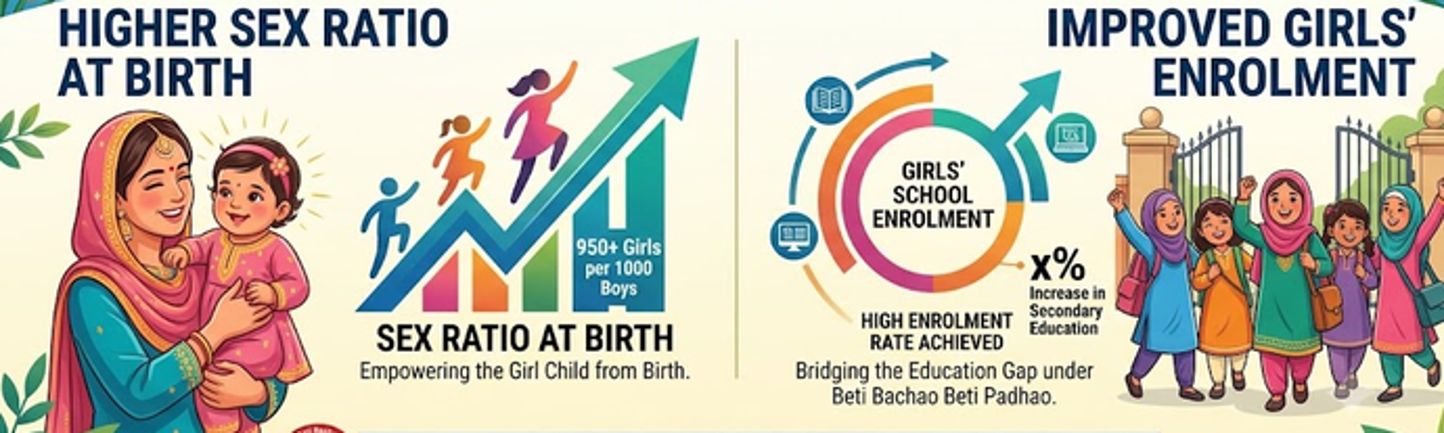
Srinagar: The Centre on Thursday informed the Rajya Sabha that the Sex Ratio at Birth (SRB) in Jammu and Kashmir has improved from 936 in 2014-15 to 957 in 2025-26 (provisional), while the Gross Enrolment Ratio (GER) of girls at the secondary school level has increased from 62.03 per cent to 68.8 per cent during the same period under the Beti Bachao Beti Padhao (BBBP) initiative.
Replying to an unstarred question by Rajya Sabha MP Sat Paul Sharma, Minister of State for Women and Child Development Savitri Thakur said the flagship scheme has evolved from a policy initiative into a nationwide movement aimed at improving the status of the girl child by addressing the child sex ratio and promoting education and empowerment through behavioural and social change.
The Minister said the Beti Bachao Beti Padhao scheme seeks to tackle the issue of declining child sex ratio while encouraging the education, protection and empowerment of girls by informing, influencing, motivating and engaging communities, government agencies, civil society organisations and the media.
She informed the House that during the 15th Finance Commission period, the scheme was expanded as a component under the SAMBAL vertical of Mission Shakti, bringing all districts of the country, including those in Jammu and Kashmir, under its ambit through multi-sectoral interventions designed to generate greater on-ground impact.
Quoting the latest Health Management Information System (HMIS) data of the Ministry of Health and Family Welfare, the Minister said Jammu and Kashmir has recorded a steady improvement in the Sex Ratio at Birth, which increased from 936 in 2014-15 to 957 in 2025-26 (provisional).
Similarly, according to the Unified District Information System for Education (UDISE) maintained by the Ministry of Education, the Gross Enrolment Ratio of girls at the secondary school level in Jammu and Kashmir has risen from 62.03 per cent in 2014-15 to 68.8 per cent in 2025-26, reflecting improved access to secondary education for girls.
The Minister said the scheme primarily focuses on bringing about lasting behavioural and social change in the way society perceives the girl child. It has mobilised a wide range of stakeholders—including government departments, educational institutions, media organisations, civil society groups and local communities—to promote gender equality and improve opportunities for girls across the country.
On the financial aspect, the Minister informed Parliament that Beti Bachao Beti Padhao is a 100 per cent Centrally Sponsored Scheme, under which the Central Government provides full financial assistance to States and Union Territories. The responsibility for implementation, however, rests with the respective State Governments and Union Territory administrations.
She said funds are released in accordance with the guidelines of the Department of Expenditure through the Single Nodal Agency (SNA) or SNA-SPARSH mechanism under the Public Financial Management System (PFMS) to ensure transparency and accountability in fund utilisation.
According to the financial details placed before the House, the Centre released ₹305 lakh to Jammu and Kashmir during the 2024-25 financial year. The Union Territory reported utilisation of ₹579.10 lakh, with the higher expenditure attributed to the utilisation of unspent balances carried forward from previous years.
For the 2025-26 financial year, the Centre released ₹250.67 lakh, all of which has been fully utilised by the Union Territory administration, the Minister said.
The government reiterated that the scheme continues to focus on improving the status of the girl child through sustained awareness campaigns, community participation, institutional convergence and targeted interventions aimed at enhancing survival, education and empowerment outcomes for girls across the country.