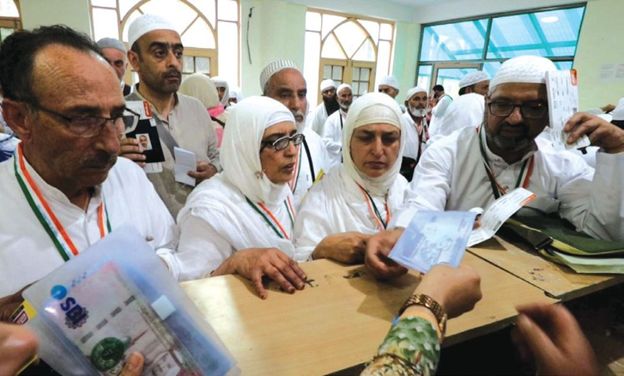
Only 4,700 applications received against quota of 7,983 seats
Pilgrims cite soaring travel expenses as major reason for declining participation
Srinagar|Aug, 1: Jammu and Kashmir, which once witnessed intense competition for Hajj seats with thousands of applicants depending on a draw of lots, is now witnessing the opposite trend, with a large portion of its annual pilgrimage quota remaining unfilled due to soaring travel costs.
Official figures reveal that the Jammu and Kashmir Hajj Committee has received only around 4,700 applications for Hajj 2027 against the Union Territory’s allocation of 7,983 seats, leaving more than 3,200 seats vacant.
Executive Officer of the J&K Hajj Committee, Dr Shujaat Ahmad Qureshi told Kashmir Horizon that the application process concluded on July 20. “We have received nearly 4,700 applications against the allotted quota of 7,983 pilgrims. Unlike previous years, there is no shortage of seats; instead, the challenge is the declining number of applicants,” he said.
According to officials, the estimated expenditure for performing Hajj in 2027 is expected to be around Rs 4.5 lakh per pilgrim, making the pilgrimage increasingly unaffordable for many families.
Officials attributed the decline primarily to rising airfare, accommodation and other pilgrimage-related expenses, coupled with inflation and the financial burden on households.
The trend marks a significant shift from previous years when the number of applicants far exceeded the quota. In 2023, the committee received nearly 14,500 applications against an allocation of 7,981 seats, prompting the administration to obtain around 4,000 additional seats from the national pool to accommodate more pilgrims.
Since then, the number of applicants has steadily fallen. Around 7,000 applications were received in 2024, followed by about 3,700 in 2025, nearly 4,600 in 2026, and 4,700 this year.
Officials said that in earlier years, selection through a computerized draw of lots was common because demand consistently outstripped availability. However, the recent decline has virtually eliminated the need for such a process.
Officials in the Hajj Committee said awareness campaigns and facilitation measures continue, but acknowledged that affordability has become the biggest hurdle for prospective pilgrims.
Several intending pilgrims, said the escalating cost of the pilgrimage has forced many families to postpone their plans despite having the desire to perform Hajj.
Abdul Rashid Mir, a prospective pilgrim from Beerwah Budgam, said he had postponed his Hajj plans because of the rising expenses.
“Performing Hajj is a lifelong dream, but arranging over Rs 4 lakh for a single person has become extremely difficult. Many families are delaying the pilgrimage because of financial constraints,” he said.
Another applicant, Ghulam Mohammad Dar from Sopore Baramulla, echoed similar concerns.
“Earlier, the biggest challenge was getting selected through the quota. Now the challenge is arranging the money. Costs have increased sharply over the last few years,” he said.
Officials said while facilitation measures remain in place, affordability has emerged as the biggest factor influencing the declining number of Hajj applications from Jammu and Kashmir.