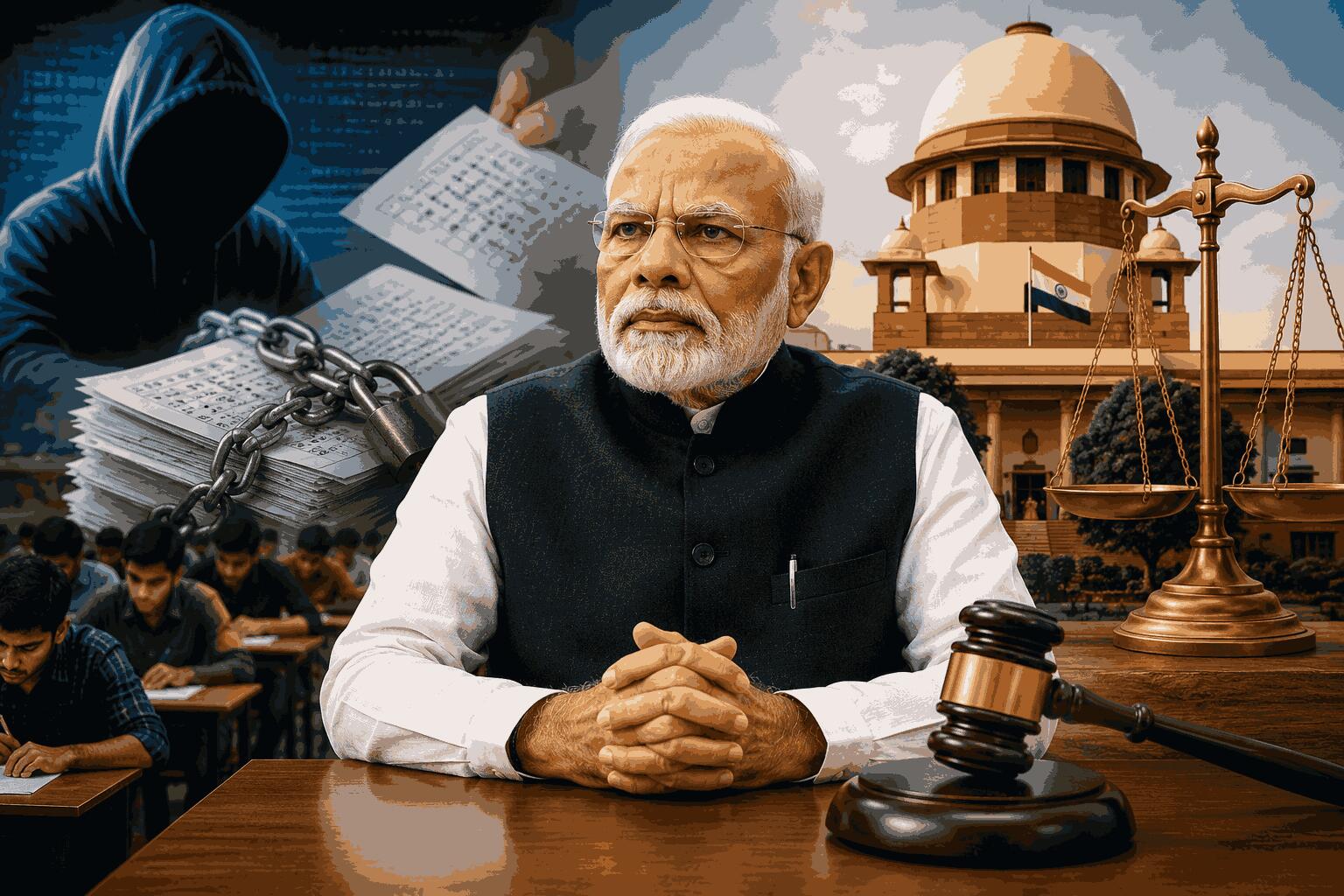
New Delhi, Jul 24 (UNI) The union Cabinet on Friday approved a draft bill proposing substantially tougher punishments for examination paper leaks, marking the Centre’s most stringent legislative response yet to recurring exam malpractices as it seeks to restore public confidence in the country’s examination system following a series of controversies over competitive examinations.
As per reports, the proposed legislation provides for a maximum punishment of 10 years’ imprisonment and a fine of up to Rs 10 crore for individuals and organized syndicates involved in examination paper leaks.
Government sources said the legislation, cleared by the Cabinet, is likely to be introduced in Parliament next week.
The proposed law also envisages prosecution of offenders through fast-track courts, reflecting the government’s effort to ensure swift justice while creating a stronger deterrent against organised examination fraud.
The Cabinet’s decision came hours after Prime Minister Narendra Modi announced that the government would strengthen the legal framework against paper leaks and that a draft bill would be placed before the Cabinet before being introduced in Parliament during the ongoing Monsoon Session.
In a post on social media platform X on Thursday night, the Prime Minister had said, “More strict actions against paper leaks to come in tomorrow’s Cabinet!”
In a video message, Modi described examination paper leaks as a matter of deep concern for students and asserted that protecting the future of the country’s youth remained the government’s highest priority.
“Nothing is more important than the welfare and future of our youth! We have decided to set up fast-track courts to ensure swift and stringent punishment for those involved in paper leaks. Have directed the concerned authorities and officials to take all necessary steps in this regard. This continues our series of steps for safeguarding the interests of students,” he said.
Issuing a stern warning to those involved in examination fraud, the Prime Minister added, “Those who try to harm the future of our youth will not be spared.”
The PM’s message, which came after midnight, was instrumental in activist Sonam Wangchuk ending his 26-day hunger strike at the Medanta hospital.
Besides prescribing harsher penalties, the proposed legislation is expected to streamline investigations and judicial proceedings through fast-track mechanisms to secure quicker convictions in paper leak cases.
The move comes amid mounting public anger over alleged irregularities in competitive and recruitment examinations, particularly the controversy surrounding the alleged NEET paper leak, which has triggered nationwide student protests and emerged as one of the biggest political flashpoints confronting the government.
The issue has also dominated the ongoing Monsoon Session of Parliament. Congress and other INDIA bloc parties have repeatedly disrupted proceedings in both Houses, demanding the resignation of union Education Minister Dharmendra Pradhan and accusing the Centre of failing to protect the integrity of public examinations.
Opposition parties have maintained that they will not participate in parliamentary debates until the Education Minister steps down. Their protests have led to repeated adjournments of both the Lok Sabha and the Rajya Sabha, effectively washing out the first week of the Monsoon Session.
The government, however, has rejected the Opposition’s allegations and asserted that it remains committed to protecting students through legislative, administrative and technological reforms. It has accused the Opposition of avoiding a substantive discussion on the issue despite its stated willingness to debate examination reforms in Parliament.
The bill, when introduced in Parliament next week, is expected to trigger a sharp political debate, with the government projecting it as a decisive step to curb examination fraud, while the Opposition continues to press for accountability over the alleged failures that led to recent paper leak controversies.