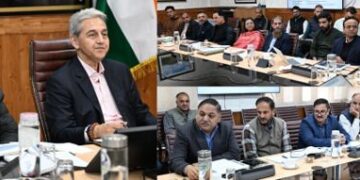

Srinagar: Chief Secretary, Atal Dulloo, Wednesday chaired a high-level review meeting to assess the current status of the Multidimensional Poverty Index (MPI) in Jammu and Kashmir and deliberated upon targeted interventions required for further reducing poverty levels across the UT.
The meeting was attended by Additional Chief Secretary, Power Development Department; Additional Chief Secretary, Finance Department; Commissioner Secretary, Food, Civil Supplies and Consumer Affairs; Commissioner Secretary, Planning, Development and Monitoring Department; Commissioner Secretary, Health and Medical Education; Commissioner Secretary, Social Welfare Department; Secretary, Rural Development Department and senior officers of the Planning Department. Deputy Commissioners of all districts participated through video conferencing.
Addressing the meeting Chief Secretary emphasized the importance of identifying vulnerable households, particularly those under the Antyodaya Anna Yojana (AAY), to implement effective poverty alleviation strategies. He directed the Planning Department to analyze data from the upcoming NFHS-6 survey to create district-specific action plans aimed at enhancing health, education, and living standards, thereby accelerating poverty reduction. The Chief Secretary highlighted existing Centrally Sponsored Schemes, such as the National Food Security Act and Ayushman Bharat, as vital tools for improving living conditions and reducing deprivation, advocating for the convergence of these initiatives with increased capital expenditure. The meeting also underscored the significance of the Multidimensional Poverty Index (MPI) as a comprehensive measure of poverty that goes beyond income, capturing deprivations across health, education, and living standards. Current MPI estimates, based on NFHS-5 data, indicate a substantial decline in the Multidimensional Poverty Head Count Ratio in Jammu and Kashmir, from 12.56 percent in 2015-16 to 4.80 percent in 2019-21, with over 10.45 lakh individuals moving out of poverty. This progress aligns with the Sustainable Development Goal of halving multidimensional poverty by 2030. District-specific insights revealed that Doda, Ramban, Rajouri, Poonch, and Udhampur experienced the most significant reductions in multidimensional poverty, particularly in rural areas, where the poverty rate dropped from 16.37 percent to 6.10 percent. The intensity of poverty also improved, indicating better living standards and access to essential services. However, districts like Ramban and Reasi still reported high poverty ratios, necessitating targeted interventions. Conversely, urban areas like Jammu and Srinagar showed remarkable improvements, with poverty rates as low as 0.49 percent and 1.34 percent, respectively. The meeting concluded with a review of the impact of various government schemes on poverty reduction, highlighting the collective efforts in health, education, housing, and financial inclusion that have contributed to improved living standards across the region. The need for tailored strategies to address both the incidence and intensity of poverty at the district level was emphasized to ensure sustained progress.