
- Centre credits fencing and maritime vigilance for ending infiltration and smuggling
- Seeks district-specific SOPs to tackle drones, narcotics and illegal settlements
- Border villages to receive full coverage of Central and State welfare schemes
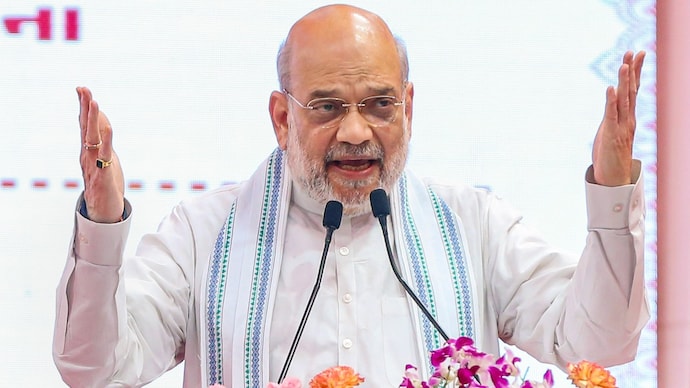
Bhuj: Union Home Minister Amit Shah on Saturday chaired a high-level security review meeting in Gujarat’s Bhuj, asserting that infiltration and cross-border smuggling into the state have been completely halted due to enhanced border fencing, strengthened maritime security and the state’s “firm political resolve.”
The meeting, attended by Gujarat Chief Minister Bhupendra Patel, Deputy Chief Minister Kanubhai Desai, senior state officials, district magistrates and police chiefs from border districts, focused on challenges and emerging threats along the India-Pakistan border and Gujarat’s coastline.
Shah said the security situation in Gujarat had undergone a “significant transformation” in recent years, attributing it to improved border infrastructure and coordinated enforcement efforts. However, he directed officials to maintain heightened vigilance against new and evolving threats, including illegal infiltration, radicalisation, drone activity, narcotics trafficking and financial crimes.
Calling for a “zero-tolerance” approach, the Home Minister instructed authorities to remove all unauthorised encroachments within the 15-kilometre belt along the international border and closely monitor centres that could potentially facilitate radicalisation in border areas.
He also directed district administrations to track demographic changes in border districts and submit regular reports, indicating the Centre’s increasing focus on population trends in strategically sensitive regions. Shah noted that reverse migration driven by industrial development in border areas was a positive development that could strengthen local economies and security.
In a strong message on illegal immigration, Shah said all levels of administration — from police stations to revenue officials — must work in coordination to identify and deport illegal infiltrators already settled in border regions. He asked district administrations to prepare district-specific Standard Operating Procedures (SOPs) to address challenges related to infiltration, drone incursions and narcotics smuggling.
The Home Minister also sought a wider security architecture beyond conventional border policing. He directed the formation of Security Coordination Groups in every border district, bringing together the Border Security Force (BSF), Indian Coast Guard, Income Tax Department, Enforcement Directorate (ED) and banking authorities.
Shah emphasised that border security must be linked with financial surveillance, calling for strict monitoring of hawala transactions, mule bank accounts, shell companies, suspicious vehicle movements and unusual GST patterns in border districts. He asked agencies dealing with economic offences to intensify coordination and directed the Income Tax Department and the Reserve Bank of India to undertake extensive surveys in sensitive areas.
Given Gujarat’s long coastline and proximity to the International Maritime Boundary Line with Pakistan, Shah also stressed the need to strengthen coastal security mechanisms and ensure seamless coordination with the Indian Coast Guard.
The Home Minister further instructed officials to ensure full saturation of Central and State welfare schemes in border villages under the Vibrant Villages Programme, arguing that development and security must go hand in hand in strategically important regions.
The review meeting comes amid continued efforts by the Centre to strengthen border management through a combination of surveillance, infrastructure development, intelligence gathering and financial monitoring, particularly in areas adjoining Pakistan. PIB