• Fourth-generation artisan aims to build premium handmade brand ‘Khaar Wan’
• Workshop now employs local youth as demand rises nationwide
Srinagar :In an era where many traditional occupations are fading away, 18-year-old Aqib Ahmad Ahanger from KapranVerinag in South Kashmir’s Anantnag district is rewriting the story of Kashmir’s centuries-old blacksmith community with pride, passion and innovation.
Belonging to the Ahanger community traditionally known for blacksmiths in Kashmir, Aqib represents the fourth generation of artisans in his family.
While many youngsters are moving away from hereditary professions in search of white-collar jobs, Aqib has chosen to carry forward the sound of hammer and iron that once defined his forefathers’ lives.
“Our elders used to migrate to Jammu during winters for work. My grandfather worked in many places before finally setting up a shop in Chenani area of Udhampur during the 1990s,” Aqib recalls while working beside the furnace at his family workshop.
His father later continued the trade, spending decades shaping iron tools by hand to earn a livelihood for the family. Aqib, who completed his Class 12 examinations in 2024, says he initially learned the craft only to preserve the family tradition.
“At first, I thought I would just learn it to keep our tradition alive. But later I realized I genuinely loved this work,” he says.
Despite criticism from relatives and peers, Aqib says he is committed to the profession. Many youth hesitate to enter traditional occupations because they consider them “old-fashioned” and feel embarrassed, he said.
“My father used to say it is a very hard job. It truly is physically demanding, but once I developed interest, I started enjoying every moment of it. There should be no shame in honest work,” he says.
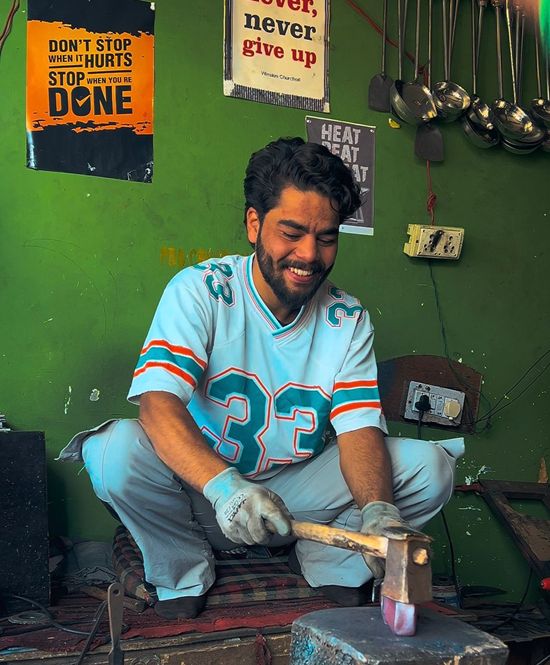
Inside the workshop, sparks fly as iron is heated, hammered and transformed into tools used in homes and farms across the region.
Over the years, Aqib has mastered the making of knives, scissors, sickles, axes, farming tools, kitchen blades, iron cutters and customised hand tools skills he learned entirely from his father.
Today, the family workshop employs three to four local youth who are learning the art under Aqib’s father, helping preserve a craft that is steadily disappearing from Kashmir.
But Aqib is not limiting himself to traditional methods alone. He believes innovation and modern marketing are essential to keeping such crafts alive in the modern era.
“Today, we can make almost any type of tool required in agriculture or households. Quality and improvement are very important,” he says.
During the Covid lockdown, Aqib explored online business and e-commerce, even experimenting with drop shipping after investing nearly Rs 12,000 to Rs 13,000. Though the venture did not succeed as expected, it opened his eyes to digital opportunities for traditional businesses.
“I realised that instead of selling others’ products online, I could promote our own craft,” he says.
Soon after, Aqib began showcasing his work through social media platforms. In the recent months, his videos displaying traditional blacksmithing techniques have gone viral, drawing attention from across the country.
Currently, he says, the workshop receives nearly 50 to 55 orders in one month from different states including Maharashtra, Gujarat, Jammu & Kashmir and other parts of India.
“We focus mainly on quality. People appreciate handmade products because they last longer and carry originality,” he says proudly.
Apart from continuing the family business, Aqib now dreams of pursuing formal education in the field through an Industrial Training Institute (ITI) course to modernise the craft further and encourage more youth participation.
“I want to study this professionally so I can help other youngsters see this as a career opportunity,” he says.
The family also runs a shop at Dooru Shahabad in Anantnag district, where many customers still prefer handmade tools over factory-made products.
Aqib believes Kashmir’s traditional crafts can survive only if the younger generation stops looking down upon manual work.
“My message to youth is simple, respect every profession. Learn traditional skills as well. If someone follows their passion sincerely, success will eventually come,” he says.
Filled with ambition, Aqib now hopes to build his own premium handcrafted brand named “Khaar Wan”, inspired by Kashmir’s artisan identity.
“I feel proud of this work and I want to take it to greater heights. One day, I want ‘Khaar Wan’ to become a recognised premium brand from Kashmir,” he added.