• Party seeks liquor ban on lines of Gujarat and Bihar after Srinagar protest
• NC accuses BJP of ‘hypocrisy’ over liquor ban demand
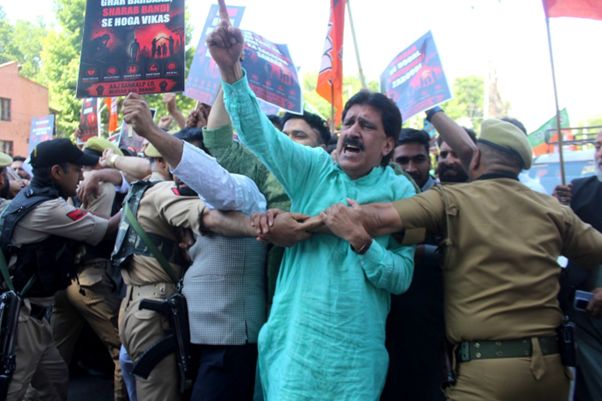
Srinagar: The debate over prohibition in Jammu and Kashmir intensified on Thursday after the BJP staged a protest near Chief Minister Omar Abdullah’s residence in Srinagar, demanding a complete ban on liquor in the Union Territory and mounting fresh pressure on the ruling National Conference government.
Led by BJP spokesperson Altaf Thakur, party leaders and workers gathered on Gupkar Road carrying banners and placards seeking total prohibition on the sale and consumption of alcohol in J&K.
The protesters attempted to march towards the Chief Minister’s residence but were stopped by police personnel and later dispersed peacefully.
Addressing protesters, Thakur said the BJP supports a complete prohibition policy in Jammu and Kashmir similar to BJP-ruled Gujarat and Bihar.
He announced that the party would launch a series of demonstrations across Kashmir, stretching from Qazigund in south Kashmir to Karnah near the Line of Control.
“Liquor is prohibited in Islam, and other religions also discourage its consumption. Its growing availability is damaging the social fabric and affecting the younger generation,” Thakur said.
The BJP, however, rejected the argument that central approval or compensation was necessary for imposing prohibition.
Thakur said the Excise Department falls under the Finance Ministry headed by the Omar Abdullah government and asserted that the administration has full authority to impose a ban independently.
“If the Assembly brings a proposal for liquor prohibition, we will fully support it,” he said, adding that sectors like tourism, handicrafts and forestry could compensate for any revenue loss arising from prohibition.
BJP state co-media incharge Sajid Yousuf Shah demanded an immediate ban on liquor in the Valley.
“A message was given to Omar Abdullah sahib that BJP’s Kashmir unit wants a ban on liquor sale in Kashmir. The ruling party’s ministers are justifying the liquor sale and our protest was also aimed at condemning it,” Shah said.
The protest by BJP comes amid an ongoing political debate over liquor sales in Jammu and Kashmir.
The political row erupted over a remark by Chief Minister Omar Abdullah that no one was being forced to consume alcohol and that people visited liquor shops by their own choice.
The demand for prohibition has gained momentum following a sharp rise in excise revenue generated through liquor sales in Jammu and Kashmir.
Official figures show that the Union Territory collected nearly Rs 2,152 crore in excise revenue during the last two years, including Rs 184.48 crore from Kashmir division alone.
The ruling NC hit out at the BJP “hypocrisy” on the liquor. It alleged that BJP itself facilitated liquor policy changes.
“We fully respect the sentiments of these 20 BJP workers. But one must ask: which government was in power in J&K when the 2017 Excise Policy made Municipal Wards and Tehsils the basis for identifying unreserved areas? And which government was in office in 2022 when liquor sales were permitted in grocery shops?,” the NC posted on X.
Srinagar district recorded the highest liquor revenue in the Valley with Rs 65.57 crore collected during 2024–25, while Jammu district accounted for Rs 509.13 crore, reflecting the scale of alcohol trade across the UT.
The issue has also triggered political sparring between opposition parties and the ruling National Conference.
Earlier this year, Chief Minister Omar Abdullah had ruled out any immediate proposal to declare Jammu and Kashmir a dry Union Territory, arguing in the Assembly that prohibition could fuel illegal smuggling, impact tourism and adversely affect government revenue.
His remarks drew criticism from several religious organisations and opposition parties, including the PDP, Congress, Apni Party and Peoples Conference, all of whom have demanded restrictions on liquor sales citing concerns over rising addiction among youth.
J&K’s Grand Mufti and various civil society organisations have also appealed to the government to impose a ban, calling alcohol consumption a growing social threat.
The debate further intensified after National Conference president and former chief minister Farooq Abdullah recently recalled an interaction between his father Sheikh Mohammad Abdullah and former Prime Minister Morarji Desai after the 1977 elections.
According to Farooq Abdullah, Morarji Desai had advised Sheikh Abdullah to ban liquor in Kashmir, to which the latter reportedly replied that the government would do so if the Centre compensated the revenue earned through alcohol sales.
Farooq Abdullah later said that if the Centre provided financial support to offset revenue losses, the government could ban liquor sales “within two minutes”.
The National Conference, meanwhile, accused the BJP of politicising the issue.
Senior NC leader Nazir Ahmad Gurezi termed the protest a “drama” and said the government would not take decisions under political pressure.
“Our government will not shut liquor shops on BJP’s call. We will take a decision independently whenever required,” Gurezi said.