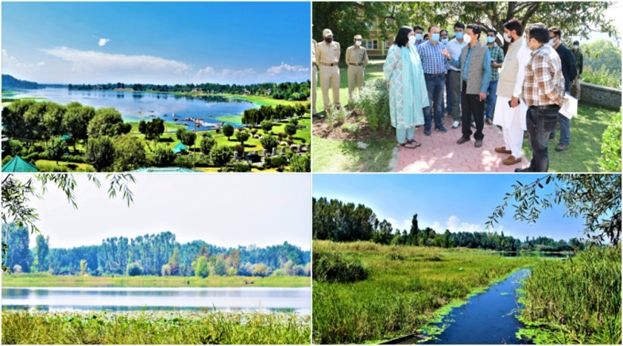
Wetlands are unique ecosystems where water either permanently or seasonally saturates the soil or shapes both land and life. The word “wetland” is derived from the combination of two independent words ‘wet’ and ‘land’ which primarily gives the idea of a land saturated with water, that may house certain plants and “animals” (Ansari and Oseni, 2012). Wetland has lot of importance in ecology, biodiversity and maintaining various natural cycles. The largest wetlands in the world, roughly ranked by total area are Amazon Basin with approximate area ~6,000,000 km2 (South America, Brazil, Peru, Colombia, Bolivia, Ecuador, Venezuela), Pantanal with approximate area ~150,000-195, 000 km2(South America, Brazil, Bolivia, Paraguay), West Siberian Lowland with approximate area ~2,600,000 km2 (Russia), Hudson Bay Lowlands with approximate area ~320,000 km2 (Canada), Sudd with approximate area ~30,000-130,000 km2 (South Sudan), Okavango Delta with approximate area ~15, 000 km2 (Botswana). In fact, wetlands are essential not just for wildlife including fish and migratory birds but also for ecological balance, groundwater recharge and local livelihoods. There are many different types of wetlands, each determined by its hydrology, water chemistry, soils, and the plant species found there. Wetlands may be characterized as dominated by trees, shrubs, or herbaceous vegetation. They may be fed by precipitation, runoff, or groundwater, with water chemistry ranging from very acidic to alkaline. According to Article-1 of the Convention on wetlands of international importance especially as waterfowl Habitat (1971), “wetlands are areas of marsh, fen, peat land or water, whether natural or artificial, permanent or temporary, with water that is static or flowing, fresh, brackish or salt, including areas of marine water the depth of which at low tide doesn’t exceed 6-metres. These are habitats where water saturation determines the nature of plants and animals, whether aquatic or terrestrial, that are found in such areas (Cowardin, et al., 1979).
Wetlands are features transitional between terrestrial and aquatic systems where the water table is usually at or near the surface or the land is covered by shallow water. Wetlands for the purpose of this classification must have one or more of the three characteristics i.e., (i) at least periodically the land supports predominantly hydrophytes. (ii) The substrate is predominantly un-drained hydric soils; and (iii) The substrate is non-soil and is saturated with water or covered by shallow water at some time during the growing season each year. Wetlands are transitional habitats in the sense that they are neither terrestrial nor aquatic, but exhibit characteristics of both. Their boundaries are part of a continuum of physical and functional characters, and may expand or contract over time depending upon factors such as average annual precipitation, evapotranspiration and modifications to the watershed. The transitional nature of wetland characteristics and the shifting of wetland boundaries render precise identification of wetland boundaries, if not possible (Moirangleima, 2010). It is reported that wetlands vary according to their origin, geographical location, water-regime, chemistry, dominant plants and soil or sediment characteristics (Maltby, 1986). The classifications of wetlands have been suggested from time to time as earlier classification describes wetland types on the basis of flooding, depth, dominant forms of vegetation and salinity regimes. At international level, wetlands have been classified by many scholars and Academicians (e.g., Dugan, 1990).
We know, Jammu and Kashmir is home to several significant wetlands, many of which are vital for biodiversity, hydrology, and local communities. Some of the key ones include:
(i) Wular Lake – One of the largest freshwater lakes in Asia and a Ramsar Site, crucial for flood regulation and rich biodiversity.
(ii) Hokersar Wetland – A high-altitude marshland near Srinagar, important for resident and migratory birds.
(iii) Surinsar–Mansar Lakes – Twin lakes with high ecological and cultural significance.
(iv) Hygam Wetland Conservation Reserve – Located in Baramulla district; known for diverse bird species along the Central Asian Flyway.
(v) Shallabugh Wetland Conservation Reserve – Known for reed beds and bird habitats; also designated for conservation. The wetlands of Kashmir are mostly located in the flood plan of River Jehlum and Sind and are characterized by the varying in Hydroedaphic features. All the wetlands are linked with each other. Wetlands form a significant part of our ecosystem. Wetlands can decrease flooding remove pollutants from water, recharge groundwater, protect shorelines, provide habitat for wildlife, and perform other various important functions.
The wetlands of Kashmir valley can also be classified in a comparatively easier way on the basis of various characteristics like altitude, size (water-spread area) status of wetland, location, and source of water. The Jammu & Kashmir region has 3651 big and small wetlands. The well known Wetlands of Kashmir Valley of J&K are given as under:
S.No. Name of Wetland District Present Status
1. Khushal Sar Srinagar Marshy
2. Gilsar Srinagar Habitation/Marshy
3. Ahansar Srinagar Marshy/Agriculture
4. Anchar lake Srinagar Plantation/Habitation/agriculture
5. Nagin lake Srinagar Marshy/Habitation
6. Dale lake Srinagar Marshy/Habitation/Agriculture
7. Rampur Taloo Anantnag Playground
8. Chakla Nambal Anantnag Agriculture land
9. Munshahun Taloo Anantnag Agriculture
10 Kiel Khanun Taloo Anantnag Agriculture
11 Buta Sar Kupwara Buta Sar
12 Tekipur Kupwara Seasonal
13. Nonn Khan Chak Kupwara Seasonal
14. Wudina Sar Baramulla Agriculture
15. Tsore Teng Baramulla Seasonal
16. Malipur Baramulla Marshy
17. Wullar Lake Bandipora Marshy/Plantation/Agriculture
18. Haighan Jhil Baramulla Agriculture/Marshy
19. Gadsar Baramulla Agriculture
20. Rakhi Malanpur Pulwama Agriculture
21. Chowkidar Sar Pulwama Agriculture
22. Baner Nambal Pulwama Horticulture
23. Bod Sar Pulwama Marshy/Agriculture
24. Rakhi-Arth Budgam Land/Agriculture
25. Nambli Narkur Budgam Plantation/Agri/Marshy/Habitation
26. Hokar Sar Budgam Plantation/Marshy/Habitation
27. Danda Rokhaw Budgam Marshy/Agriculture
Source: Directory of Lakes and Water Bodies. (2012). J&K.
“World Wetlands Day, celebrated on February 2, marks the anniversary of the Ramsar Convention and highlights the essential role wetlands play in biodiversity and landscape protection. The 2026 theme focuses on merging traditional cultural knowledge with conservation efforts, urging everyone to act as global citizens to preserve these vital ecosystems for the future.”
The winged visitors from Central Asia and Europe start arriving Kashmir valley in lakhs towards the first week of November and the concentration of migratory birds will peak around first week of February. Kashmir presents migratory birds a comparatively hospitable alternate habitat compared to the extreme freezing conditions in their natural habitats in Siberia, China, Japan and other countries in northern hemisphere. Tufted Duck, Gadwall, Brahminy Duck, Garganey, Greylag Goose, Mallard, Common Merganser, Northern Pintail, Common Pochard, Ferruginous Pochard, Red-Crested Pochard, Ruddy Shelduck, Northern Shoveler, Common Teal, and Eurasian Wigeon are some of the most sighted birds in the wetlands of Kashmir. It is reported that there are around 106 species of birds nestle in these wetlands, including 25 species of land birds which visit occasionally and several endangered species. It is noticed that nothing is being done to sort out the issues with the locals who have encroached upon the land around the wetlands in the absence of proper records. Wetlands in Kashmir are currently facing multi-dimensional threats due to human encroachments and government apathy. Public awareness is an important factor in saving wetland of Kashmir. The details of wetlands of Kashmir are given in various research papers (e.g., Dr. Shaikh Gh.Rasool, Dr. Bilal A. Bhat et al., 2019; Dr Bilal, 2020; Aliya Mehraj & Prof. Muni Parveen, 2021). Government is working hard involving departments like Forest, Irrigation & Flood Control, Urban Developmentfor the Wetland Preservations. The main challenges for the wetland preservation are (i) Encroachment & Land Grabbing (ii) Pollution & Poor Sewage Management (iii) Weak Implementation of Laws (iv) Unplanned Urbanization (v) Climate Change & Flood Mismanagement (vi) Marginalization of Local Communities. It is reported that despite strong legal frameworks, wetland preservation in Jammu & Kashmir has failed due to poor implementation, political interference, and unplanned urbanization, leading to severe ecological and social consequences.
The global effort to protect wetlands began with the Ramsar Convention, formally known as the Convention on Wetlands of International Importance, signed on 2 February 1971 in Ramsar, Iran. The Ramsar Convention is an international treaty that provides a framework for national action and cooperation for wetland conservation and wise use. World Wetlands Day is celebrated every year on 2 February to commemorate this historic event and raise awareness about the importance of wetlands worldwide. This Day was celebrated for the first time in 1997 and made an encouraging beginning.The Standing Committee of the Convention has approved the theme for World WetlandDay 2026 as “Wetlands and traditional knowledge: Celebrating cultural heritage.”This theme highlights the deep connections between wetlands and the cultural practices, traditions, and knowledge systems of communities around the world. It emphasizes how traditional wisdom helps sustain wetland ecosystems and preserve cultural identity.World Wetlands Day is important because it: (a) Raises Awareness: Educates people about the value of wetlands for the environment and human wellbeing. (b) Promotes Conservation: Encourages nations, communities, and individuals to protect and restore wetlands. (c) Supports Sustainable Development: Highlights the role of wetlands in climate resilience, water security, biodiversity, and cultural heritage. (d) Celebrates Cultural Connections: The 2026 theme especially recognizes how traditional knowledge and cultural practices have long contributed to wetland stewardship. In brief, Wetlands are vital ecosystems that sustain life, protect landscapes, support biodiversity, and enrich cultural heritage. World Wetlands Day, observed every year on 2 February, commemorates the Ramsar Convention and encourages global action to conserve and wisely use these precious environments. The 2026 theme further emphasizes the value of integrating traditional knowledge and culture in wetland conservation for a sustainable future. Let us save Wetlandsby playing our role as global citizens. Warm wishes on World Wetlands Day to everyone.
(The authors write regularly for the opinion pages of “Kashmir Horizon”. The views, opinions and conclusions expressed in this article are those of the author and aren’t necessarily in accord with the views of “Kashmir Horizon”)
[email protected]