India, UAE Move from LNG Deals to Atomic Energy
Modi, MBZ call for Unified Front Against Cross-Border Terrorism
India, UAE Join Forces on Supercomputers, 2026 AI Summit
UAE Eyes Mega-Investment in Gujarat’s Smart City
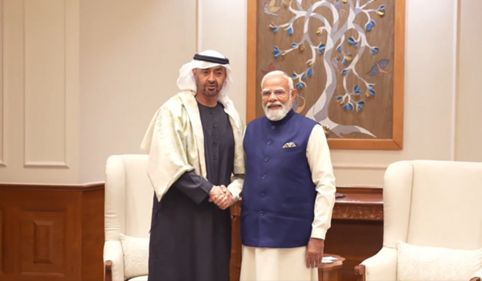
New Delhi: Prime Minister Narendra Modi on Monday held wide-ranging talks with UAE President Sheikh Mohamed bin Zayed Al Nahyan during a short but substantive two-hour visit to India on Monday, with cooperation on nuclear reactors, artificial intelligence, defence, energy security and counter-terrorism emerging as key focus areas.
Foreign Secretary Vikram Misri said that during the discussion booth Prime Minister Modi and UAE President Sheikh Mohamed bin Zayed Al Bahyan highlighted their “extremely warm and close relationship,” focusing on various strategic areas of cooperation. Key agreements and letters of intent were exchanged, emphasizing the robust India-UAE partnership. The UAE delegation included prominent figures such as Sheikh Hamdan bin Mohammed bin Maktoum, Crown Prince of Dubai, underscoring the significance of the meeting. Energy security was a central theme, with the signing of a 10-year LNG supply agreement between Hindustan Petroleum Corporation Limited and ADNOC Gas, positioning the UAE as one of India’s largest LNG suppliers. This agreement reflects the UAE’s increasing role in meeting India’s long-term energy requirements amid global market fluctuations. Additionally, civil nuclear cooperation emerged as a priority, with both nations agreeing to explore partnerships in advanced nuclear technologies, including large reactors and Small Modular Reactors (SMRs), following India’s enactment of the SHANTI law. The discussions also emphasized collaboration in artificial intelligence and emerging technologies, with plans to establish a supercomputing cluster in India and explore UAE investments in data centers. The concept of “Digital Embassies” was introduced, aimed at fostering mutual recognition of sovereignty in digital infrastructure. Sheikh Mohamed expressed support for India hosting the AI Impact Summit in February 2026. Defence cooperation was strengthened through a Letter of Intent for a Strategic Defence Partnership, building on recent military exchanges. Both leaders condemned terrorism, particularly cross-border terrorism, and committed to ongoing cooperation to combat terror financing and money laundering. Economic cooperation was another focal point, with bilateral trade reaching $100 billion in FY 2024–25, following the Comprehensive Economic Partnership Agreement in 2022. The leaders set a target of $200 billion in trade by 2032 and discussed UAE involvement in the development of the Special Investment Region in Dholera, Gujarat, which includes infrastructure projects. Further initiatives such as Bharat Mart and the Virtual Trade Corridor were directed to enhance connections for MSMEs across West Asia, Africa, and Eurasia. In the space sector, both countries agreed to collaborate on commercializing space science and technology. Food security and agricultural cooperation were also addressed, with an anticipated MoU on food safety benefiting Indian farmers and enhancing food resilience in the UAE. The leaders acknowledged the importance of people-to-people ties, noting the presence of approximately 4.5 million Indians in the UAE, and agreed to promote youth exchanges and establish a ‘House of India’ in Abu Dhabi. Finally, the leaders discussed regional and global developments, reaffirming their commitment to peace and stability in West Asia. The UAE expressed support for India’s BRICS chairmanship in 2026, while India backed the UAE-hosted UN Water Conference later that year. Sheikh Mohamed expressed gratitude to Prime Minister Modi for the warm reception, marking the visit as a significant step in the ongoing expansion of India-UAE strategic ties.