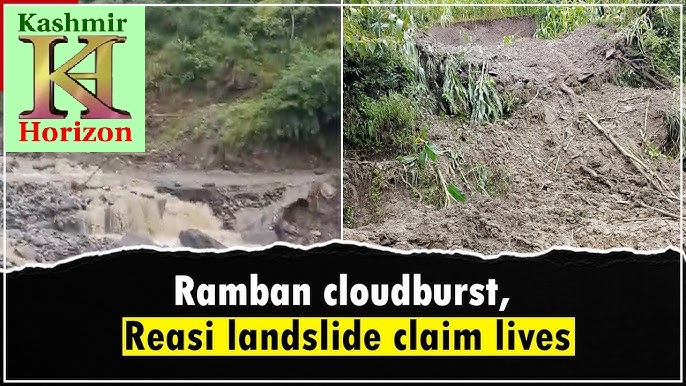
Srinagar: Nature’s fury returned to Jammu and Kashmir on Saturday with devastating consequences. A cloudburst triggered by relentless overnight rains struck Ramban district, killing four people and leaving one missing, while in neighbouring Reasi, a massive landslide flattened a house in Badar village, wiping out an entire family of seven—including five children. The twin tragedies have once again underlined the vulnerability of the Himalayan region to extreme weather events, particularly cloudbursts and flash floods, which have become alarmingly frequent in recent years.
 Ramban Cloudburst|Panic at Dawn : According to officials, the cloudburst occurred in Rajgarh tehsil of Ramban in the early hours of Saturday. Torrential rains led to sudden surges of water, triggering flash floods and multiple landslides. Several houses sustained damage as mud and debris swept through narrow valleys. “Four people lost their lives on the spot, while one person is still missing. Rescue teams are on the ground and efforts are underway to trace the missing person,” a senior official of Ramban administration said. Teams from the State Disaster Response Force (SDRF), police, and local administration, along with volunteers from nearby villages, immediately swung into action. Despite continuing rain and challenging terrain, the rescue teams managed to pull several survivors from under the debris.
Reasi Landslide: Family Of Seven Buried Alive: In neighbouring Reasi district’s Mahore area, the impact of the heavy downpour was no less catastrophic. At Badar village, a house belonging to 38-year-old Nazir Ahmed was reduced to rubble when a landslide thundered down the slope. Ahmed, his wife Wazira Begum, and their five children, all inside at the time, were buried under tons of debris. “By the time neighbours rushed to the spot, the house had completely vanished under mud and rocks. The screams faded within minutes,” recalled a local resident who joined the rescue efforts. Rescuers, including SDRF teams, police personnel, and local volunteers, are still working to retrieve the bodies. Authorities fear no one inside the house has survived.
Government Response|CM’s Urgent Directives: Expressing deep sorrow, Chief Minister Omar Abdullah called the deaths “a heart-wrenching tragedy that has shaken the entire Union Territory.” In a statement posted on X (formerly Twitter), the CM said:“The loss of innocent lives, especially children, in these tragedies is unbearable. I have directed the district administration and disaster management authorities to remain on the ground, ensure round-the-clock monitoring, and provide immediate relief and assistance to affected families.” The CM appealed to people to remain vigilant and strictly follow safety advisories, especially in hilly terrain prone to landslides. “Evacuation of residents from risk-prone zones must be prioritised. Every precautionary measure should be taken to safeguard lives in this inclement weather,” Abdullah added.
Cloudbursts|A Recurring Nightmare: The twin incidents come against the backdrop of a series of deadly cloudbursts in Jammu and Kashmir this month alone. August 14, 2025: A catastrophic cloudburst in Chesoti village of Kishtwar killed 68 people, while 32 remain missing. The site, on the pilgrimage route to Mata Machail temple, witnessed flash floods that swept away homes, roads, and bridges. August 26, 2025: Another massive cloudburst caused landslides on the route to the Vaishno Devi shrine, claiming 34 lives, most of them pilgrims, and injuring 23 others. Rescue operations are still underway at the site. Environmental experts warn that such incidents are no longer isolated freak events but part of a disturbing trend linked to climate change.
Expert Voices: Climate Change & Himalayan Fragility, Dr Abbas Adil, environmental activist said that Himalayan region, including Jammu and Kashmir, is experiencing a clear spike in extreme weather events. Rising global temperatures are increasing the frequency and intensity of short-duration, high-intensity rainfall events that often trigger cloudbursts and flash floods. These are classic symptoms of climate change.” He added that unplanned development in ecologically fragile zones—such as road widening, deforestation, and unchecked construction—further aggravates the impact of such disasters. Environmental activist Sunita Narain of the Centre for Science and Environment echoed similar concerns: “Cloudbursts may be natural, but their consequences are magnified when we alter natural drainage systems, destabilize slopes, and ignore scientific warnings. The tragedy in Ramban and Reasi is a wake-up call for long-term adaptation strategies, not just short-term rescue operations.” For the residents of Badar village in Reasi, Saturday turned into a day of unbearable grief. Nazir Ahmed’s relatives sat in stunned silence near the debris of the flattened house, waiting for the bodies to be recovered. “They were a simple family, earning livelihood from farming. The children were bright and playful. It feels unreal that they are all gone in one moment,” said a sobbing villager. In Ramban’s Rajgarh, survivors recounted how walls of water and mud came roaring down. “It was like the sky cracked open. We ran for our lives, but some of our neighbours didn’t make it,” said Mohammed Shafi, a local shopkeeper.
A Region On Edge : The Jammu-Srinagar highway, the only all-weather road linking the Valley to the rest of the country, has already been frequently disrupted this monsoon due to landslides in the Ramban-Udhampur belt. The fresh spell of heavy rains has heightened the risk of further blockages and isolation of remote villages. Meteorological officials have warned of continued heavy rainfall in the region over the next 48 hours, raising the spectre of more cloudbursts, landslides, and flash floods. Residents in vulnerable areas have been urged to stay alert and cooperate with authorities in evacuation efforts.
Lessons From The Past : Experts say J&K must draw lessons from past disasters, such as the 2014 floods in Srinagar, which killed nearly 300 people, and the frequent cloudburst incidents in Ladakh and Kishtwar. Despite repeated tragedies, disaster preparedness and early warning systems remain inadequate. Dr. Imtiyaz Ahmad, a disaster management expert at Kashmir University, stressed the need for scientific planning: “We require community-based disaster preparedness, investment in real-time weather monitoring, and resilient infrastructure. Without these, every heavy rainfall event risks turning into a large-scale tragedy.” Union Home Minister Amit Shah, in a message from New Delhi, assured full support from the Centre for rescue and relief operations. “We stand with the people of Jammu and Kashmir in this hour of grief,” he said. The deaths of 11 people, including five children, in Ramban and Reasi are not isolated accidents but part of a grim pattern of escalating climate disasters in Jammu and Kashmir. As scientists warn of more extreme weather in the coming years, the Himalayan region stands at a crossroads: it must strengthen disaster preparedness, respect ecological limits, and adapt to a changing climate—or risk facing tragedies of even greater magnitude. For now, families in Ramban and Reasi are left to mourn their dead, praying that the rains relent and that the mountains they call home stop collapsing around them.