Rev receipts: Rs. 98,719 crore; Capital receipts: Rs. 19,671 Cr.
Rev expenditure: Rs. 81,486 crore; Capital expenditure: Rs. 36,904 Cr.
GDP projected at Rs. 2,63,399 crore; Tax-to-GDP ratio: 7.92%.
Tax revenues up 9% with significant GST and excise increases.
5.74 lakh smart meters cut T&D losses by 25%.
Rs. 17,000 crore special assistance package approved.
Power capacity to rise from 3,500 MW to 6,500 MW by 2026-27.
889 units with Rs. 18,185 crore investment
$100 million IFAD loan for agricultural development.
Gurez Valley connected to the grid; significant tourism boost.
Rs. 4,061.74 crore allocated, up Rs. 118.87 crore.
Industrial Devt: 46 new estates and 1,372 units under J&K REGP planned.
Start-Up Policy: New policy to foster entrepreneurship.
Science and Technology: Rs. 159.80 crore allocation, up Rs. 71.80 crore.
Solar Initiatives: 4,000 AC pumps to be replaced by solar pumps.
Transport Sector: IDTR and ICC projects in Jammu expected in 2024-25.
Vehicle Safety: VLTP for women’s safety; RVSF policy introduced.
Biotechnology Park: Operationalization at Kathua planned.
Agricultural Projects: Rs. 5,013 crore for Holistic Agriculture Dev Prog.
Rail Connectivity: Baramulla-Banihal train services extended to Sangaldan.
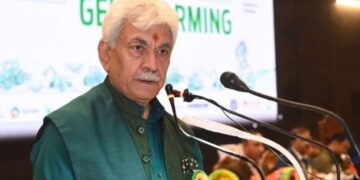
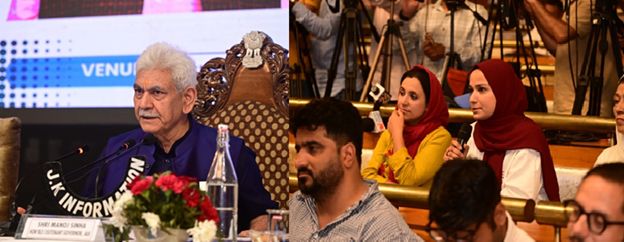
Srinagar: Lieutenant Governor Manoj Sinha expressed his gratitude to Prime Minister Shri Narendra Modi and Finance Minister Smt. Nirmala Sitharaman for their commitment to accelerating and ensuring inclusive growth in Jammu and Kashmir, meeting the aspirations of its citizens.
The Jammu and Kashmir’s budget for FY 2024-25, tabled in Parliament on July 23, 2024, and passed on August 8, 2024, stands at Rs. 1,18,390 crore—an increase of Rs. 30,889 crore over the previous year’s expenditure. He outlined the revenue and capital estimates for the fiscal year 2024-25, noting that revenue receipts are projected at Rs. 98,719 crore, while capital receipts are estimated at Rs. 19,671 crore.
LG Sinha said that revenue expenditure is set at Rs. 81,486 crore, with allocations of Rs. 9,881.68 crore for the administrative sector, Rs. 24,870.50 crore for the social sector, Rs. 15,719.40 crore for the infrastructure sector, and Rs. 5,555.48 crore for the economic sector. “The capital expenditure, also referred to as developmental expenditure, totals Rs. 36,904 crore. This amount is allocated across sectors as follows: Rs. 1,190.50 crore for the administrative sector, Rs. 4,217.65 crore for the social sector (including Rs. 1,675 crore for health and medical education), Rs. 11,664.45 crore for the infrastructure sector (with Rs. 4,062 crore dedicated to public works), and Rs. 6,943.20 crore for the economic sector (with Rs. 3,731.54 crore allocated to rural development),” he said.
LG Sinha said that contribution of capital expenditure to GDP is projected at 14.01%. The Gross State Domestic Product (GSDP) for 2024-25 is expected to reach Rs. 2,63,399 crore, reflecting a 7.5% growth over the previous year. Additionally, the tax-to-GDP ratio is projected to increase to 7.92%, up from 5.68% in the prior year, he said. He said that Jammu and Kashmir has faced significant challenges in fiscal management, largely due to the persistent pressures of externally sponsored terrorism. These issues have been further exacerbated by high levels of committed expenditure and ATC losses in the power sector. “To address these challenges, the UT government has focused on revenue augmentation, improving project execution, reducing ATC losses, and enhancing governance quality over the past year,” he said.
LG Sinha said that J&K Government has implemented several measures to boost revenue. These include improving GST return compliance, introducing an e-Stamping system, expanding dealer registration, and conducting transparent excise auctions. “As a result, tax revenues increased by 9%, from Rs. 12,753 crore in 2022-23 to Rs. 13,900 crore in 2023-24. GST collections rose by 12%, and excise collections saw a 39% increase in FY 2023-24 compared to the previous year.”
LG Sinha said that in the power sector, the installation of 5.74 lakh smart meters by June 2024 led to a 25% reduction in Transmission & Distribution (T&D) losses and a 10% increase in monthly tariff collections. Additionally, efforts to improve billing and collection efficiency boosted non-tax revenues by 25%, from Rs. 5,148 crore in 2022-23 to Rs. 6,500 crore in 2023-24, he added. The J&K Government has effectively leveraged Centrally Sponsored Schemes (CSS), leading to a sharp increase in receipts under CSS from Rs. 6,400 crore in 2022-23 to Rs. 10,300 crore in 2023-24.
Technology reforms have been implemented to enhance transparency and accountability in budgeting and expenditure management, including the physical monitoring and verification of developmental works by independent officers. A systematic drive was initiated for Aadhar seeding and biometric verification to clean databases of welfare schemes, and competitive procurements through GEM and e-Tendering have led to cost savings of Rs. 400 crore annually. He said in recent years, the UT government has improved budgetary transparency and repaid power sector dues of about Rs. 28,000 crore, which had been pending for several years. “For the first time in 77 years, the UT contributed to the contingency funds created by the RBI, namely the Consolidated Sinking Fund and Guarantee Redemption Fund. Fiscal discipline was strengthened in 2023-24, with a curtailment of the practice of raising Hundis and overdrafts. The UT government also brought off-budget borrowings onto its books and began timely repayments, resulting in a gradual reduction of such borrowings,” he said. LG Sinha said that these efforts have led to significant improvements in the UT’s revenues, reduction in wasteful expenditure, and enhanced fiscal transparency. “Coupled with judicious welfare measures and infrastructure development, these initiatives have contributed to the doubling of J&K’s GDP from Rs. 1.17 lakh crore in 2015-16 to Rs. 2.45 lakh crore in 2023-24, with an expected increase to Rs. 2.63 lakh crore in 2024-25,” he said.
The Lt. Governor said that this remarkable economic growth was achieved despite the challenges posed by massive floods in Kashmir, ongoing terrorism, and the economic shock of the COVID-19 pandemic. “The turnaround of J&K Bank further reflects the region’s accelerated growth and strengthened economic foundations. From a loss of Rs. 1,139 crore in 2019-20, the bank reported a profit of Rs. 1,700 crore in 2023-24, with its NPA reduced from 11% to the current level of 5%. The bank is now focused on improving professionalism, efficiency, and transparency in its operations,” he said. Recognizing these improvements in financial management, the Union Government has approved a special assistance package of Rs. 17,000 crore for Jammu and Kashmir in the current financial year 2024-25.
LG Sinha said due to the ongoing threat of externally sponsored terrorism, around 11% of J&K’s budget is allocated to internal security and policing, leaving limited funds for development and welfare projects. To alleviate this burden, the Central Government has allocated Rs. 12,000 crore for J&K Police in its annual budget. “Additionally, a special additional grant of Rs. 5,000 crore is being provided as central assistance this year. This infusion of funds will reduce the fiscal deficit to GDP ratio to 3.0% in this financial year, enabling the UT government to meet the developmental needs and aspirations of its people while maintaining stable fiscal health,” he said.
Lt. Governor said that Government of India is steadfast in its commitment to enhancing power generation in Jammu and Kashmir, aiming to increase the capacity from 3,500 MW to approximately 6,500 MW by 2026-27. “As part of this initiative, the central government has already provided an equity share of Rs. 2,430.60 crore for the development of four new hydroelectric projects in the Union Territory. This significant investment underscores the government’s dedication to addressing the region’s power needs, which will, in turn, foster the growth of tourism and industries, ultimately driving economic development and job creation,” he said.
LG Sinha said that in addition to boosting power generation, the Government of India has introduced the New Central Sector Scheme (NCSS) in 2021, with a substantial outlay of Rs. 28,400 crore aimed at stimulating industrial development in Jammu and Kashmir. “Since the scheme’s inception, a total of 889 units have commenced operations on the ground, with proposed investments amounting to Rs. 18,185 crore and the creation of 46,857 jobs. To date, the region has witnessed an actualized investment of Rs. 6,600 crore, highlighting the scheme’s early success in attracting significant capital to the region,” he said.
LG Sinha said furthering its commitment to agricultural development, the Government of India has secured a $100 million loan from the International Fund for Agricultural Development (IFAD) for the Competitiveness Improvement of Agriculture and Allied Sectors project in Jammu and Kashmir. This initiative is expected to generate employment opportunities for 2.8 lakh farmers, thereby enhancing livelihoods and promoting sustainable agricultural practices in the region. “Additionally, 29 projects have been approved under the Holistic Agriculture Development Programme, with an investment of Rs. 5,013 crore over five years. This ambitious program aims to double the contribution of agriculture to the Gross State Domestic Product (GSDP) and create livelihood opportunities for 13 lakh farmer families,” he said. In the realm of infrastructure and connectivity, Kashmir will soon be fully integrated with the rest of the country via the railway network.
LG Sinha said that existing train services from Baramulla to Banihal have been extended to Sangaldan, and the entire section has been electrified. “This development marks a significant milestone in improving the region’s connectivity, facilitating the movement of people and goods, and contributing to the overall economic growth of Jammu and Kashmir,” he said. “Tourism is another sector receiving a substantial boost, with the government focusing on border tourism in areas like Gurez, Keran, Lolab, and Karnah,” he said. LG Sinha said in 2023, these areas witnessed a remarkable increase in domestic tourist arrivals, with 1.5 lakh visitors exploring the region’s pristine landscapes. Notably, Gurez Valley, which had remained without electricity since Independence, has now been connected to the grid, further enhancing its appeal as a tourist destination, he said.
LG Sinha the Government of India continues to prioritize the holistic development of Jammu and Kashmir across various sectors, including agriculture, tourism, power, and infrastructure, with a clear focus on creating jobs, improving livelihoods, and driving sustainable economic growth. “These initiatives, backed by substantial financial investments, underscore the government’s unwavering commitment to the region’s prosperity and development,” he said. LG Sinha said that for the year 2024-25, an allocation of approximately Rs 4,061.74 crore has been earmarked for capital expenditure in the road and bridge sector. This represents an increase of Rs 118.87 crore compared to the revised allocation for 2023-24.
Lieutenant Governor Sinha highlighted that this enhanced budget aims to significantly improve infrastructure and connectivity across the region, ensuring more robust and reliable road and bridge networks. He said that Central Government’s New Central Sector Scheme (NCSS), launched in 2021 with an outlay of Rs 28,400 crore, continues to drive industrial development in Jammu and Kashmir. “Under this scheme, 889 units with a proposed investment of Rs 18,185 crore and expected to create 46,857 jobs are already underway. To date, investments worth Rs 6,600 crore have been realized,” he said.
LG Sinha said that plans for rapid development include the establishment of 46 new Industrial Estates to attract investment and create employment opportunities. The Jammu and Kashmir Rural Employment Generation Programme (J&K REGP) targets the setup of 1,372 units during 2024-25. “Additionally, a new Start-up Policy will be introduced to foster an entrepreneurial ecosystem, existing Industrial Estates will be upgraded, and the Private Industrial Estate Development Policy will be revamped. It is anticipated that 324 units will come into production this year, providing employment for 18,000 individuals,” he said. The LG said that for the Industries and Commerce sector, an allocation of about Rs 534.62 crore has been set aside for capital expenditure in 2024-25, marking an increase of Rs 138.36 crore over the revised allocation for 2023-24. “Significant advancements are planned for the Science and Technology sector. A phased replacement of 4,000 AC agriculture pumps with solar pumps will be carried out under the PM-KUSUM Component “C”,” he said.
LG Sinha said approximately 04 MW of rooftop solar power plants are to be installed on government buildings, with a goal of solarizing 22,494 government buildings in phases. “A 100 kW floating solar power plant will be established in Dal Lake, Srinagar, to attract tourists. Additionally, 5,000 improved biomass cook-stoves will be distributed in tribal areas to mitigate indoor air pollution,” he said. Lt. Governor said that efforts will also focus on identifying land for solar park development, complete solarization of tourist and religious sites under the Special Area Development Programme (SADP), and the solarization of all routes and camps of Shri Amarnath Ji Yatra. “The Bio-Technology Park at Kathua is set to become operational, and science talent scholarships will be awarded to undergraduate and postgraduate students. Young Scientist Awards and Fellowships will recognize outstanding researchers.”
He said for the Science and Technology sector, an allocation of Rs 159.80 crore has been made for 2024-25, an increase of Rs 71.80 crore over the revised allocation for 2023-24. “In the Transport sector, several key projects are underway. The IDTR at Kot Bhalwal, Jammu, is expected to be completed and operationalized in 2024-25, along with the Institute of Inspection and Certification Centre (ICC) at Samba, Jammu.” He said that implementation of a Vehicle Location Tracking Platform (VLTP) aims to enhance the safety of women in public transport vehicles. Automated Testing Stations (ATSs) will be set up in the private sector for motor vehicle fitness testing. “A new policy will introduce Registered Vehicle Scrapping Facilities (RVSF) for the scientific dismantling and scrapping of End of Life Vehicles (ELVs). Additionally, the construction of a Modern Bus Terminal at TRC, Srinagar, is planned,” he said. LG Sinha said that for the Transport sector, an allocation of Rs 22 crore has been made for capital expenditure in 2024-25, reflecting an increase of Rs 8.11 crore compared to the revised allocation for 2023-24.