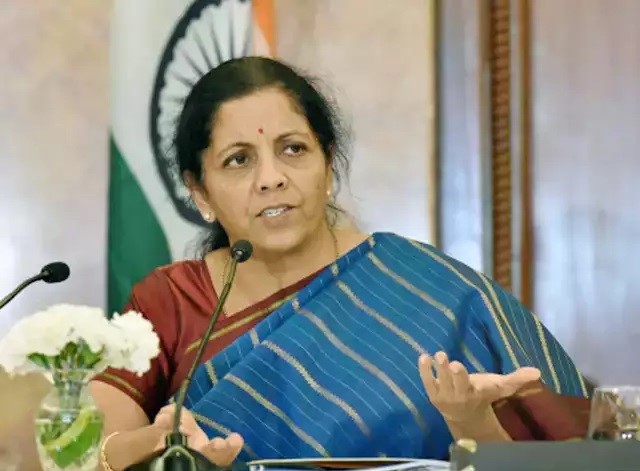
New Delhi | Jan, 31 : Union Finance Minister Nirmala Sitharaman on Monday tabled the Economic Survey 2021-22 in the Lok Sabha soon after President Ram Nath Kovind’s address to both Houses of Parliament. Ms Sitharaman will present the Budget for 2022-23 on Tuesday (February 1). The pre-Budget survey presents the state of the economy and suggests policy prescriptions.
The survey projected an 8-8.5 per cent growth rate for the Indian economy in the 2022-23 fiscal year (April 2022 to March 2023). The figures are in comparison with the 9.2 per cent GDP (gross domestic product) expansion projected by the National Statistical Office (NSO). The survey also detailed the state of different sectors of the economy as well as reforms to accelerate growth. The survey focused on supply-side issues to improve the resilience of the Indian economy. One of the most-watched numbers in the Economic Survey is the projection of the GDP for the next fiscal. The survey is authored by a team led by the Chief Economic Advisor (CEA).
Just days before the presentation, the Centre appointed economist V Anantha Nageswaran as the new CEA. Mr Nageswaran, an academic and former executive with Credit Suisse Group AG and Julius Baer Group, succeeds K V Subramanian, who demitted the office of CEA in December 2021 after completing his three-year term. India’s statistics ministry has estimated the economic growth at 9.2 per cent for the current fiscal. The survey often misses on GDP forecast, sometimes by a significant margin. The economy had contracted by 7.3 per cent during 2020-21 as against the projection of 6-6.5 per cent in the survey presented months before the outbreak of the Covid-19 pandemic in 2020. Economic activities were severely impacted as India imposed a strict lockdown in the latter part of March 2020 to check the spread of the virus. The government and Reserve Bank of India (RBI) rolled out several measures to support the economy. India is poised to grow as the fastest economy in the world during the current financial year with a growth projection of around 9 per cent despite the pandemic.